

Weight Gain Before Your Period? Read the Pattern Without Panicking
A higher pre-period weigh-in may be temporary. Learn what the scale can show, when it may settle, and how to compare your progress more fairly.
Shelog Editorial
Reviewed for clarity and care

You wake up, step on the scale, and discover that it has apparently chosen drama. Yesterday's routine was ordinary. Your period is due soon. Yet the number is higher, your jeans feel snug, and your brain is already drafting a complete investigation.
Here is the calmer answer: weight gain before your period can be a temporary fluctuation, and one higher reading cannot tell you that you gained body fat. Changes in body water, bloating, appetite, digestion, meals, and movement can all affect the number around this time.
The useful question is not “What did I do wrong?” It is “Does this happen at a similar point in my cycle, and what happens next?”
Your scale is measuring more than body fat
A bathroom scale gives you one total. It cannot separate body fat from body water, food and drinks still being digested, or waste waiting to leave. Several of those can change faster than body tissue.
This is why a salty dinner, constipation, a later meal, a hard workout, or a change in routine can appear on the scale the following morning. If your period is approaching at the same time, there may be more than one contributor sharing the stage.
Premenstrual symptoms vary, but they can include bloating, appetite changes, food cravings, and digestive changes. The US Office on Women's Health explains that these symptoms may appear after ovulation and before a period, then improve within a few days after bleeding begins.
That does not mean every pre-period increase is “just hormones.” It means the timing is useful context—not a diagnosis.
How much weight gain before a period is normal?
There is no single number that works for every woman. You may see online claims that two, three, or five pounds is universally normal, but the evidence is not precise enough to turn one range into a rule for every body and every cycle.
One small 2023 study followed 42 women across their menstrual cycles. Average body weight was about 0.45 kg, or roughly 1 pound, higher during menstruation than during the first week of the cycle. The difference closely matched an increase in extracellular water; the researchers did not find significant changes in the other body-composition measures. You can read the study abstract in the National Library of Medicine.
That result is helpful, but modest. It shows that a measurable fluid change can blur a short-term weight comparison. It does not predict your personal number, prove when your highest day will occur, or establish a medical cutoff for “normal.”
Your own repeating pattern is more informative than borrowing someone else's range from the internet.
When does period weight usually go away?
There is no universal drop day. For some women, bloating and a higher scale reading appear before bleeding and ease shortly after it starts. For others, the highest reading arrives during the first few days of the period. Some notice little or no repeatable change.
The Office on Women's Health says PMS symptoms usually improve within a few days after a period begins. But your scale may also be responding to meals, bowel movements, travel, sleep, exercise, and medications, so it may not follow a tidy calendar.
Think of the timeline as a soft pencil sketch:
- In the days before your period: bloating, cravings, appetite changes, constipation, or looser stools may join the picture.
- Around the start of bleeding: symptoms and scale weight may still be present; this is not a guaranteed reset button.
- Over the following days: a temporary change may settle, although the timing varies.
If your cycles are irregular, you use hormonal contraception, or you are postpartum or approaching menopause, the pattern may look different—or be difficult to compare at all. You do not need to force your body into a perfect 28-day chart.
Try a fairer comparison before changing your plan
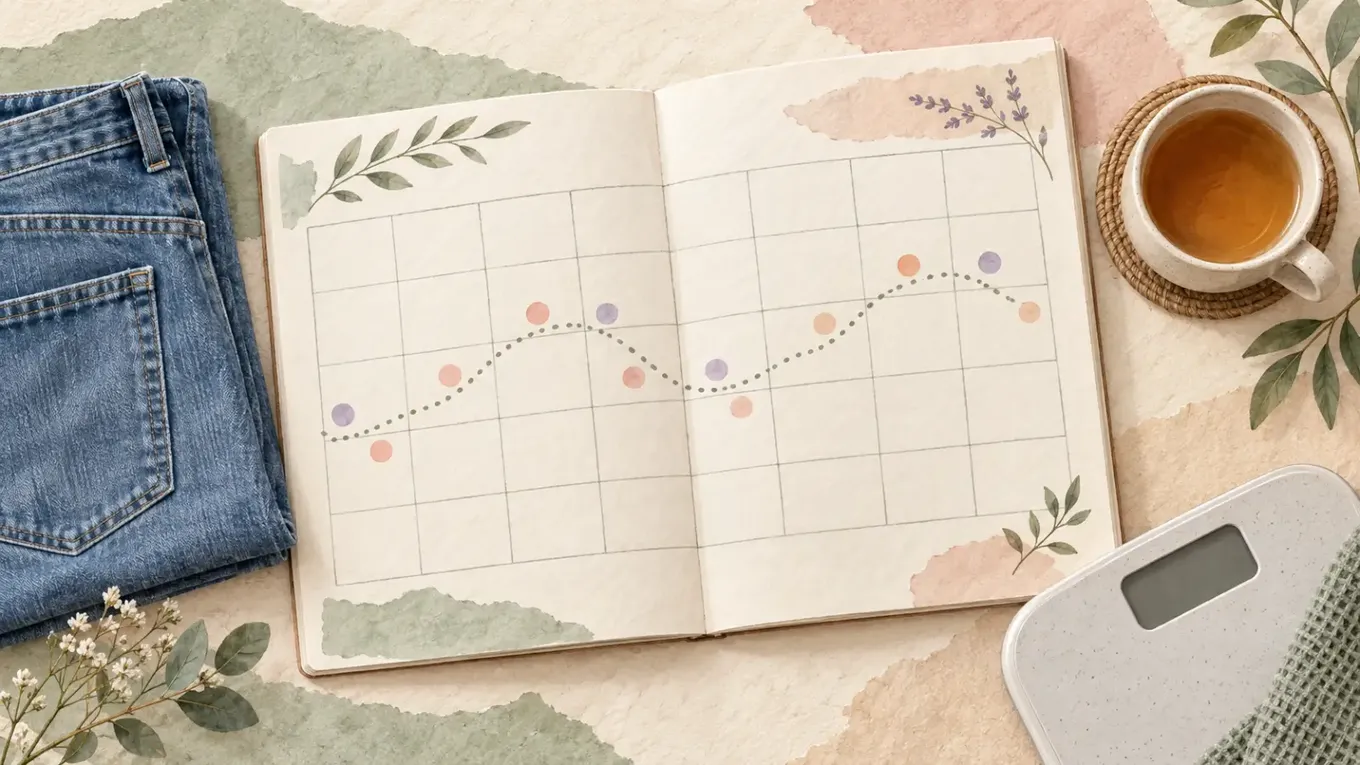
Imagine comparing a quiet Tuesday morning with the morning after a restaurant dinner, a late flight, and very little sleep. The two scale readings are real, but they are not answering the same question.
If weighing is useful to you, keep the conditions reasonably similar: the same general time of day, the same scale, and similar clothing. Then add just enough context to make the number intelligible. Your period started. Dinner was later. You are constipated. You began a new workout. No detective wall covered in red string is required.
Look at two views:
- The trend across several weeks. Is the general direction changing, even if individual days bounce around?
- Similar points in different cycles. If you already know your cycle timing, does a rise appear around the same stage and then settle again?
The second comparison is a practical observation, not a clinical test. Two or three cycles may reveal a useful personal pattern, but they cannot identify a hormone problem or prove the cause of a weight change.
If daily weighing makes you anxious, more restrictive with food, or tempted to “make up for” the number with punishing exercise, step back. A weekly check, clothing fit, energy, strength, or no weighing at all may be a kinder and more useful approach. Progress tracking is meant to provide information, not appoint the scale as your manager.
For a wider look at different progress signals, read Stages of Noticing Weight Loss.
What can you do about the fluctuation?
You do not need to launch a pre-period punishment plan. In particular, do not dehydrate yourself, slash food intake, or start an unreviewed diuretic or supplement simply to produce a lower number.
Instead, keep the basics pleasantly boring:
- Drink normally rather than trying to manipulate water weight.
- Eat regular, satisfying meals instead of reacting to one reading with severe restriction.
- Choose movement that feels manageable if cramps, fatigue, or a headache have changed the day.
- Give the pattern time to reveal itself before changing several parts of your routine.
The American College of Obstetricians and Gynecologists includes bloating, weight gain, swelling, and appetite changes among possible PMS symptoms. It also notes that recording symptoms and period dates over two to three months can help a clinician understand a suspected PMS pattern. That is especially useful when symptoms—not merely the scale—are affecting daily life.
When should you speak with a healthcare professional?
Do not automatically file every change under “my period.” Make an appointment if the increase is new, keeps rising, does not settle after the expected window, or comes with symptoms that concern you. It is also worth seeking help when bloating, mood changes, pain, appetite changes, or other premenstrual symptoms repeatedly interfere with work, school, relationships, sleep, or ordinary activities.
Get urgent medical help for sudden or severe swelling, or swelling accompanied by chest pain or difficulty breathing. MedlinePlus advises emergency care for swelling with shortness of breath or chest pain.
A clinician can consider the whole picture, including pregnancy possibility, medicines, menstrual changes, and health conditions. A scale and a calendar cannot do that job.
Let the pattern be information, not a verdict
The higher number you see before your period may be temporary. It may also reflect several ordinary things happening at once. Either way, the most useful response is rarely an immediate overhaul.
Keep your routine steady enough to compare. Notice whether the timing repeats. Look beyond a single morning. If the change persists or arrives with worrying symptoms, take the record to someone qualified to help.
Shelog's Weight Trend can estimate the recent direction of your weight records and show uncertainty, making a noisy run of numbers easier to view. It does not use your menstrual cycle, food, workouts, symptoms, or body composition to explain the cause. The value is a calmer view of the trend—not a verdict about your body.
Open Shelog and keep the next few weeks in context.
Frequently asked questions
Can you gain weight before your period even while losing fat?
Yes, it is possible for temporary changes in water or digestion to hide a change in body fat on the scale. One weigh-in cannot separate those components. Use several comparable readings and a longer trend rather than treating a pre-period number as proof that fat loss stopped.
Is five pounds of weight gain before a period normal?
There is no well-established amount that is normal for every woman. Online ranges should not be treated as personal medical cutoffs. Notice whether the change is typical for you and settles again; speak with a healthcare professional if it is new, persistent, increasing, or worrying.
What day of your cycle do you weigh the most?
There is no universal highest day. Some women notice a change before bleeding, others during the first days of their period, and some see no clear pattern. Comparing your own readings at similar stages is more useful than following a generic calendar.
Should you avoid weighing yourself before your period?
Only if the reading is not useful to you. You can keep weighing and add cycle context, compare less frequently, or pause altogether. Choose the method that provides information without driving anxiety or compensatory eating and exercise.
Sources
This article is for general education and is not a substitute for personal medical or nutrition advice.
More From Shelog
Keep Reading
Take Shelog with you
Take Shelog with you
Shelog turns the ideas in this article into a simple daily diary—food, mood, movement, and weight in one calm place.