

How to Fit Gym Workouts Into a Busy Routine—Without Starting Over Every Monday
Learn how to make gym workouts fit a busy week with realistic scheduling, shorter backup sessions, and a simple plan for missed days.
Shelog Editorial
Reviewed for clarity and care

The week can look surprisingly spacious when it is still a row of empty boxes. Then the meetings multiply. A child needs picking up. Your period arrives with cramps. A “quick errand” takes the whole evening. By Sunday, the gym sessions you meant to fit into your routine never made it off the calendar.
The answer is not to find a perfectly disciplined version of yourself.
To incorporate gym workouts into a busy routine, start with two sessions you can realistically keep, give each one a shorter backup version, and decide what you will do when plans change. Schedule the full amount of time the gym takes—including travel and changing—and simply continue with your next planned workout after an interruption. There is no need to double up or start over.
That is the short answer. Here is how to make it usable on an ordinary Wednesday.
Start With a Minimum You Can Repeat
“I will work out every day” sounds decisive. It is also a fragile plan if your recent average is zero or one gym visit a week.
Start by choosing a realistic minimum: the number of gym sessions you could still manage during a fairly demanding week. For many beginners, that may be two. It gives you a repeatable structure without depending on every weekday going to plan.
The U.S. Physical Activity Guidelines for Americans recommend that adults work toward 150–300 minutes of moderate aerobic activity each week and do muscle-strengthening activity on at least two days. The same guidance makes an important point that gets lost in ambitious schedules: inactive people can begin with smaller amounts and build gradually.
That minimum is not a limit. If a third session fits, take it. Just do not let an optional third workout decide whether the first two “counted.”
If you still need a simple strength routine to place inside those time slots, use our beginner gym workout plan for women. That guide covers exercises and progression; this one is about making room for them.
Count the Door-to-Door Time
A “45-minute workout” can take 90 minutes once you include the commute, parking, changing, finding a locker, and waiting for equipment. If your calendar cannot accommodate that, the problem is not a lack of commitment. The time window is simply too small.
For one week, look for time windows using three questions:
- When could I realistically leave for the gym?
- How long does the whole trip take, not just the workout?
- What tends to claim this time at the last minute?
Then choose a primary slot and a backup slot for each session. A plan might read:
Tuesday at 6
p.m. after work. If work runs late, Thursday at 7 a.m. If neither works, complete the 15-minute version on Saturday rather than squeezing two full sessions into Sunday.
Notice what this does not say: “Go sometime this week.” A flexible plan still needs a specific time and place.
Give One Workout Three Sizes
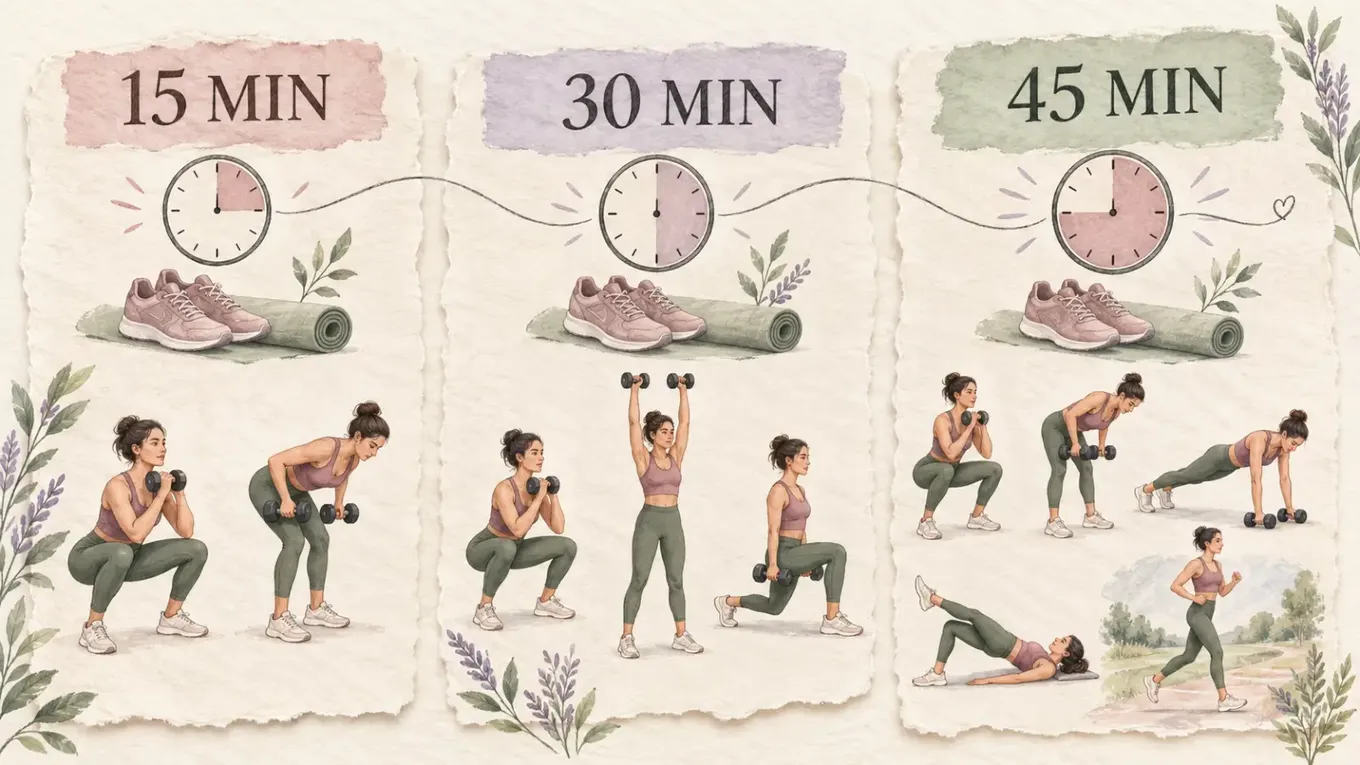
A routine is easier to keep when a busy day does not force you to invent a completely different workout. Instead, create three versions of the same basic session.
| Time available | What the session can include | The job of this version |
|---|---|---|
| 15 minutes | Brief warm-up plus two or three familiar compound movements | Keep some movement in a crowded day |
| 30 minutes | Warm-up plus the main movements, with normal rest | Cover the essentials efficiently |
| 45 minutes | Full planned workout, including accessories or easy cardio if appropriate | Use the complete session when time allows |
The 15-minute version is not a punishment circuit. You do not need to remove rest, race between unfamiliar machines, or turn every exercise into a breathless challenge. Shorter usually means fewer movements, not sloppier repetitions.
If the gym commute makes a short visit impractical, the backup can be a walk or a simple home session instead. It does not have to imitate the gym perfectly. Its purpose is to keep you moving without pretending that a living-room workout and a fully equipped strength session are the same thing.
Plan the Obstacle While You Plan the Workout
Putting “Gym” on a calendar is an action plan. Adding “If the meeting runs late, I will use the Thursday morning slot” is a coping plan.
That second sentence matters because a predictable obstacle deserves a plan of its own.
A 2022 systematic review and meta-analysis of planning interventions included 41 randomized trials and 5,439 participants. Overall, action and coping plans led to a small improvement in physical activity, although the results varied considerably between studies. Planning can make it easier to act on an intention; it cannot remove every barrier.
Try this compact formula:
I will train at time in place for duration. If likely obstacle happens, I will specific alternative.
Examples:
- I will go straight from work to the gym on Monday for 30 minutes. If I forget my gym bag, I will take a 25-minute walk after dinner and move the strength session to Wednesday.
- I will train Saturday at 10 a.m. If family plans change, I will use the 15-minute version before lunch.
- I will go Tuesday morning. If I slept poorly and feel unsteady, I will postpone the workout rather than trying to “push through” with heavy lifts.
The alternative needs to be genuinely possible. “Wake up at 4
a.m.” is not much of a backup plan if you have never been a morning exerciser.Make the Gym Visit Easy to Start
Sometimes the hardest part of a workout happens before the first repetition. A session with a dozen small setup decisions can feel much bigger than it is.
Reduce the opening friction:
- Pack the same few essentials and keep a short bag checklist.
- Use a small set of familiar exercises instead of redesigning the workout in the parking lot.
- Know your first movement before you enter.
- Keep one alternative for equipment that is usually busy.
- Record weights and repetitions so you do not have to guess where to begin next time.
It can also help to attach the gym to something that already happens reliably: after the school drop-off, directly after work, or after Saturday breakfast. Research on exercise habits is encouraging, but it does not support a magical deadline. A 2023 systematic review and meta-analysis of physical-activity habit interventions found stronger exercise habits across ten studies, though the interventions and delivery methods varied. Repetition in a familiar context can help, but day 21 will not necessarily make the gym feel automatic.
Decide What a Difficult Day Looks Like
Decide in advance what the shortest useful gym visit looks like for you. It should be a version you can complete without needing to find a full hour.
You might arrive, warm up, perform the first two planned movements with controlled technique, record what you did, and leave. This option works best when you choose it in advance, rather than making it up while feeling guilty about being short on time.
There is also a difference between being short on time and feeling unwell. Menstrual symptoms, poor sleep, stress, perimenopause, and caregiving demands can all affect your energy and capacity, but there is no universal training calendar that works for every woman. Depending on the day, you might shorten the session, reduce the load, choose comfortable movement, or rest.
Stop exercising and seek appropriate medical advice for chest pain, faintness, unusual shortness of breath, or sharp or persistent pain. If you are pregnant, recently postpartum, returning from injury, or managing a condition that affects exercise, ask a qualified healthcare or exercise professional for guidance suited to you.
Use a Reset Rule That Does Not Create More Work
Missing one workout means the week changed. It says nothing about your character.
Use this reset rule: continue with the next planned session. Do not cram two hard workouts together, “make up” every missed minute, or wait for another Monday. If you alternate Workout A and Workout B, simply do whichever one comes next.
If you miss an entire week, make the return easy. Your first session back can use familiar exercises, fewer sets, or lighter resistance. The goal is to settle back into the routine, not test how much fitness you retained.
When the same session keeps falling through, look at the time slot rather than blaming yourself. Friday at 6
p.m. may appear free but repeatedly lose to fatigue, social plans, or unfinished work. That is useful information. Move the session.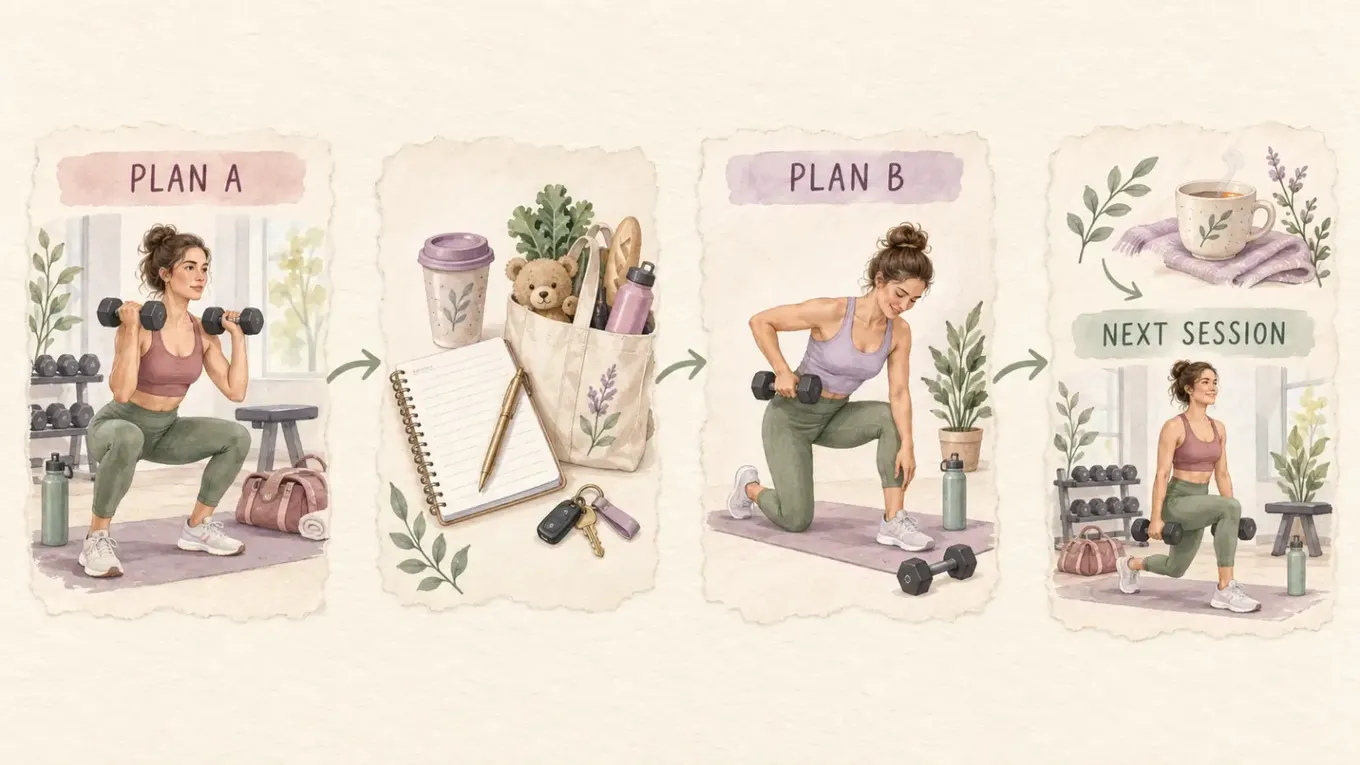
A Realistic Week Can Have More Than One Shape
Here is one two-session structure for a person with changing workdays:
| Day | Primary plan | If the day changes |
|---|---|---|
| Monday | 30-minute gym session after work | Move to Tuesday morning |
| Tuesday | Backup slot | Use only if Monday was missed |
| Wednesday | Walk or rest | Keep it easy; there is no missed-workout debt to repay |
| Thursday | 45-minute gym session | Use the 15-minute version after work |
| Friday | Open | Do not automatically fill it with missed workouts |
| Weekend | Optional enjoyable movement | Saturday becomes the final backup only if wanted |
Someone who works shifts, manages school runs, lives with chronic symptoms, or has a long commute will need a different schedule. The useful pattern is not Monday and Thursday specifically. It is a primary time + a realistic backup + a shorter version + a simple way to resume.
Review your schedule every two weeks. Keep the sessions that happened with relatively little negotiation. Move the ones that repeatedly collided with real life.
When a Personalized Plan Helps
A general schedule can give you a starting framework. It cannot know that you have 28 minutes on Tuesdays, prefer machines, are returning after a long break, or recover better with two sessions than four.
Shelog Fitness Plans use your selected goal, training background, available time, preferred intensity, workout environment, and recovery needs to shape a more personalized routine. Routine+ can help bring movement and other daily habits into the same plan, while the Shelog diary gives you a place to record workouts alongside food, mood, water, and weight.
The plans are general wellness and fitness guidance, not medical care, physical therapy, injury rehabilitation, or pregnancy and postpartum programming. You can review the scientific basis and limitations behind Shelog Fitness Plans.
Build a Fitness Plan around the time and equipment you actually have—download Shelog.
Questions About Fitting the Gym Into Your Routine
How many days a week should I go to the gym?
For a beginner, two repeatable strength sessions can be a practical starting point. This also aligns with the general recommendation to strengthen the major muscle groups on at least two days each week. Walking, cycling, sports, or other movement can make up the rest of your activity. More gym days are not automatically better if they make recovery or consistency harder.
How do I fit the gym around a full-time job?
Count the complete door-to-door time, choose two specific windows, and give each a backup. Going directly before or after work may reduce an extra transition, but only if that timing suits your energy and responsibilities. A 30-minute session near work may fit better than a longer session across town.
What are the 3-3-3 and 3-2-1 workout rules?
Different creators use those labels for different schedules, so the numbers do not represent one accepted scientific standard. A memorable rule can organize a week, but it is not superior simply because it has a name. Check whether the actual activities, progression, recovery, and time demands fit you.
What if I miss the gym for a week?
Continue with your next planned session, making the first workout back easier if needed. Avoid doubling the workload to catch up. If illness, pain, or unusual symptoms caused the break, seek appropriate professional guidance before returning.
Does a 15-minute gym workout count?
Yes. A short session is still physical activity, and it can be useful for practicing familiar movements or preserving a routine. It may not contain the same training volume as your full workout, but “shorter” and “worthless” are not synonyms.
The Takeaway
The gym is easier to fit into daily life when your plan can become shorter without disappearing altogether.
Choose a weekly minimum. Count the commute. Give each workout a full version and a shorter one. Write down the obstacle you expect and the alternative you will use. When you miss a session, continue with the plan instead of trying to repay every lost minute.
The most useful routine is not the one that looks impressive in an empty calendar. It is the one that still works when the week fills up.
Sources
This article is for general education and is not a substitute for personal medical or nutrition advice.
More From Shelog
Keep Reading
Take Shelog with you
Take Shelog with you
Shelog turns the ideas in this article into a simple daily diary—food, mood, movement, and weight in one calm place.