

Beginner Gym Workout Plan for Women: A Simple 4-Week Routine
Start strength training with a realistic 4-week beginner gym workout plan for women, including 2- and 3-day schedules, exercise swaps, and progression tips.
Shelog Editorial
Reviewed for clarity and care
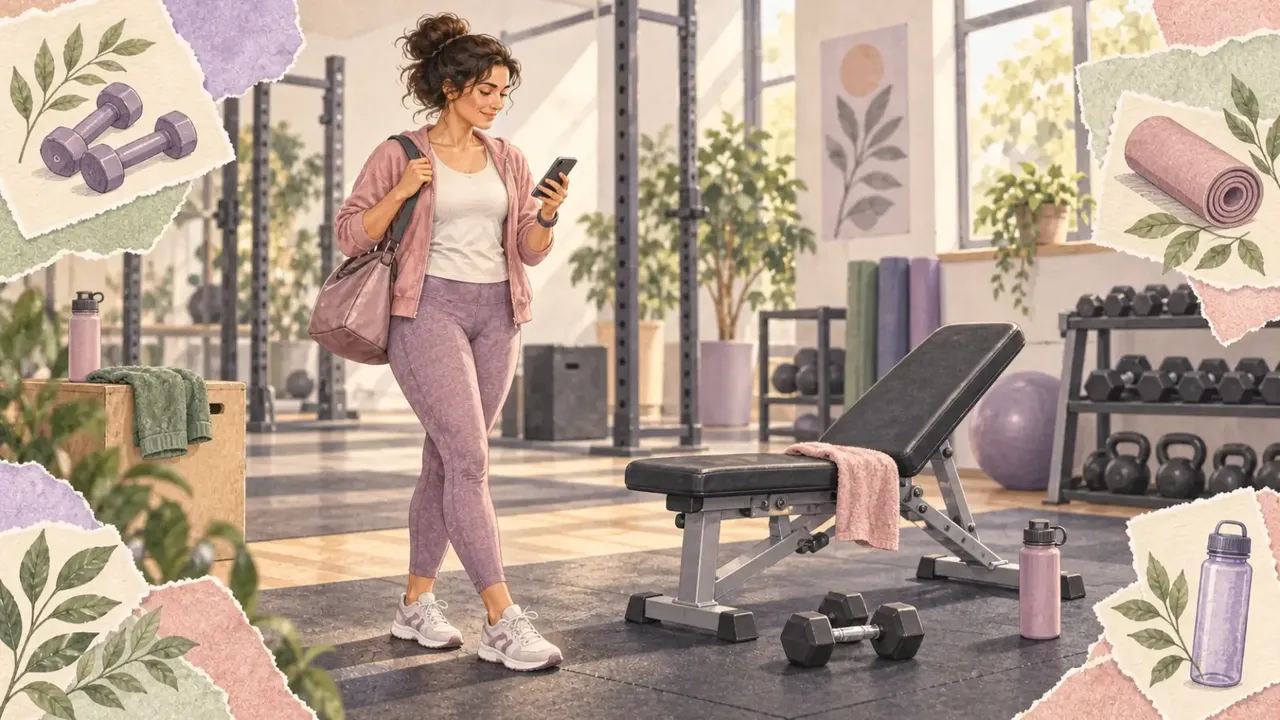
The first few minutes in a gym can feel oddly public. Everyone else appears to know which pin to move, where the clips live, and whether the bench is free. Meanwhile, you are wondering whether six exercises are enough—or whether you are supposed to stay until your legs turn to soup.
You do not need a complicated split or five gym days to begin.
A useful beginner gym workout plan trains your major muscle groups two or three nonconsecutive days each week, repeats a small number of exercises, and adds difficulty gradually. The four-week plan below alternates two full-body workouts. It is designed for healthy adult beginners and can be done mostly with machines, dumbbells, or a mixture of both.
Before You Start: Make the First Week a Learning Week
Your first goal is not to discover the heaviest weight you can lift. It is to learn how each movement and machine feels while you can still control it.
If possible, ask a qualified gym trainer to show you how to adjust the seat, safety stops, and range of motion on unfamiliar equipment. A useful demonstration is about setup and technique—not proving how hard you can work.
Choose a starting weight that lets you complete the suggested repetitions smoothly while feeling that you could still do about three more with good form. If you are holding your breath, rushing the lowering phase, shortening the movement, or rearranging your whole body to finish a repetition, the weight is probably too heavy for today.
This is a general fitness plan, not medical advice or rehabilitation. Talk with a healthcare or appropriately qualified exercise professional before starting if you are pregnant, recently postpartum, returning after an injury, managing a medical condition, or unsure whether exercise is appropriate for you.
Your Two Full-Body Beginner Workouts
Alternate Workout A and Workout B. The alternatives in the final column are options, not extra exercises—you only need one movement from each row.
Rest for about 60 to 90 seconds between sets. Take longer if you need it to breathe comfortably and repeat the movement with control.
Workout A
| Movement | Exercise | Sets and repetitions | Alternative |
|---|---|---|---|
| Legs | Leg press | 1–2 × 8–12 | Goblet squat to a box or bodyweight chair squat |
| Pull | Seated cable row | 1–2 × 8–12 | Chest-supported dumbbell row or resistance-band row |
| Push | Machine chest press | 1–2 × 8–12 | Dumbbell bench press or elevated push-up |
| Hips | Machine leg curl | 1–2 × 10–15 | Glute bridge |
| Carry | Farmer carry | 2 × 20–30 seconds | Suitcase carry, one side at a time |
Workout B
| Movement | Exercise | Sets and repetitions | Alternative |
|---|---|---|---|
| Legs | Goblet squat to a box | 1–2 × 8–12 | Leg press or bodyweight chair squat |
| Pull | Lat pulldown | 1–2 × 8–12 | Assisted pull-up machine or resistance-band pulldown |
| Push | Seated machine shoulder press | 1–2 × 8–12 | Seated dumbbell press or incline push-up |
| Hips | Glute bridge | 1–2 × 10–15 | Cable pull-through or machine leg curl |
| Trunk | Dead bug | 2 × 5–8 per side | Bird dog or short front plank |
The exact machine design varies by gym. Follow the instructions on the equipment and use an alternative if a setup does not feel comfortable or you have not been shown how to use it. No single exercise is compulsory.
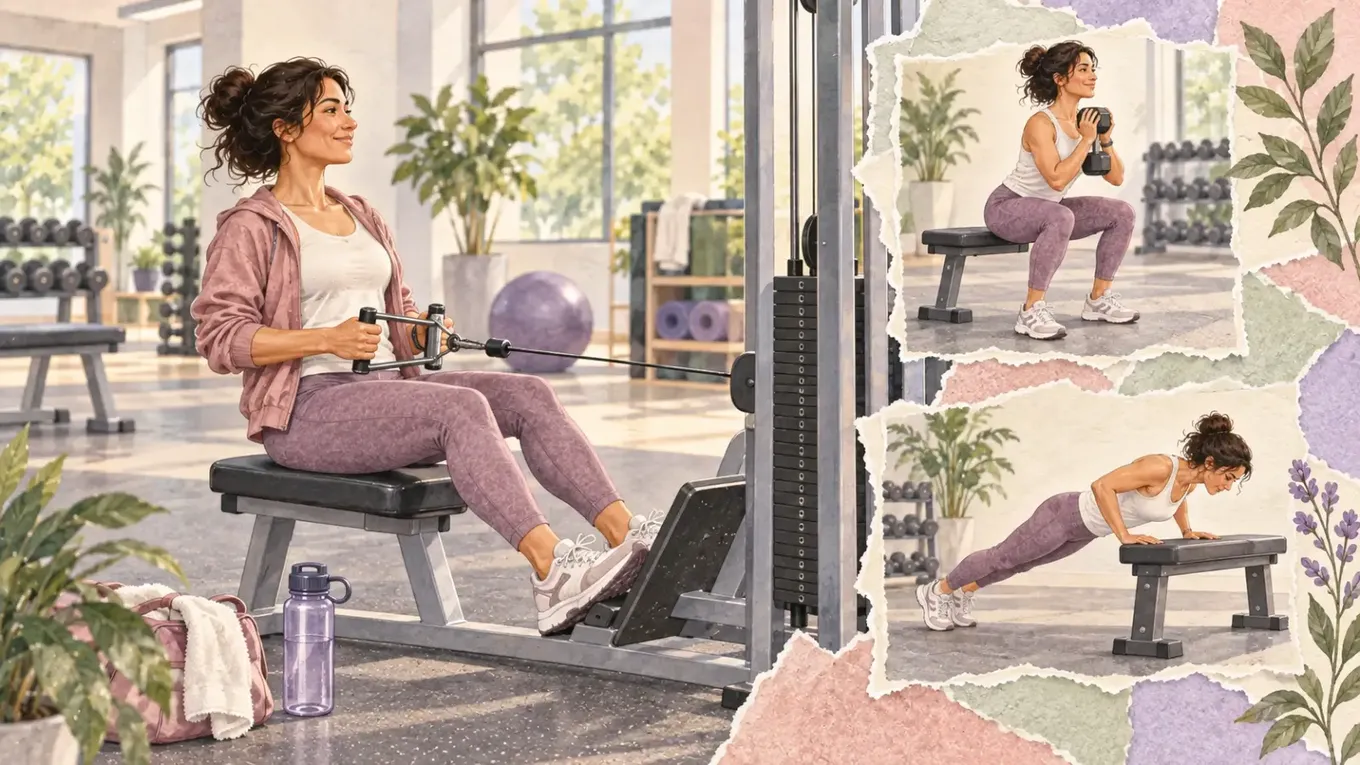
The 4-Week Beginner Gym Schedule
For three gym days, leave at least one recovery day between strength sessions. Monday, Wednesday, and Friday is one option; Tuesday, Thursday, and Saturday works just as well.
| Week | Three-day schedule | What changes |
|---|---|---|
| 1 | A / B / A | Do one working set of each strength exercise. Practice setup, range, and control. |
| 2 | B / A / B | Do two working sets of each strength exercise if week one felt manageable. |
| 3 | A / B / A | Keep two sets. Add one repetition where you can without losing form. |
| 4 | B / A / B | When both sets reach the top of the range comfortably, add the smallest available weight next time. |
Prefer two days? Do Workout A once and Workout B once each week, with at least one day between them. Use the same weekly progression. Two sessions are not the “less serious” version; they are a perfectly sensible starting structure and align with the general recommendation to strengthen the major muscle groups on at least two days each week.
If three days leaves you persistently sore, drained, or dreading the next session, use the two-day schedule. A plan earns its place by fitting your real week.
How to Choose a Starting Weight
The number printed on a dumbbell or weight stack is not a grade.
Start lighter than you think you need for the first set. Complete eight controlled repetitions, then check:
- Could you keep the same range of motion from the first repetition to the last?
- Could you lower the weight without letting it drop or race?
- Did you breathe rather than brace and hold your breath throughout?
- Could you probably complete another two or three good repetitions?
If the answer is yes, that is a reasonable working weight. If you could perform many more repetitions easily, increase it by the smallest available amount and try again. If your form changes before the lower end of the range, reduce the weight.
The latest American College of Sports Medicine position stand found that progressive resistance training improves strength and physical function, while equipment type and training to momentary muscle failure did not consistently determine results for healthy adults. For a beginner, that is liberating: you can use equipment that feels approachable, and you do not need to grind through ugly final repetitions to make the session count.
How to Progress Without Turning Every Workout Into a Test
Use a simple “repetitions first, weight second” rule.
Imagine your leg press target is 8–12 repetitions for two sets. You might complete 9 and 8 repetitions this week. Next time, keep the same weight and try for 10 and 9. When you can complete 12 controlled repetitions in both sets and still have roughly two or three good repetitions available, increase the weight by the smallest amount. Your repetitions may fall toward eight again, and the process restarts.
You do not have to progress every session. Sleep, stress, menstrual symptoms, equipment availability, and ordinary life can change how a weight feels. Keep the same load, use fewer repetitions, or choose an easier alternative when that is the more sensible session.
The useful signal is what happens over several weeks—not whether every Tuesday beats the Tuesday before it.
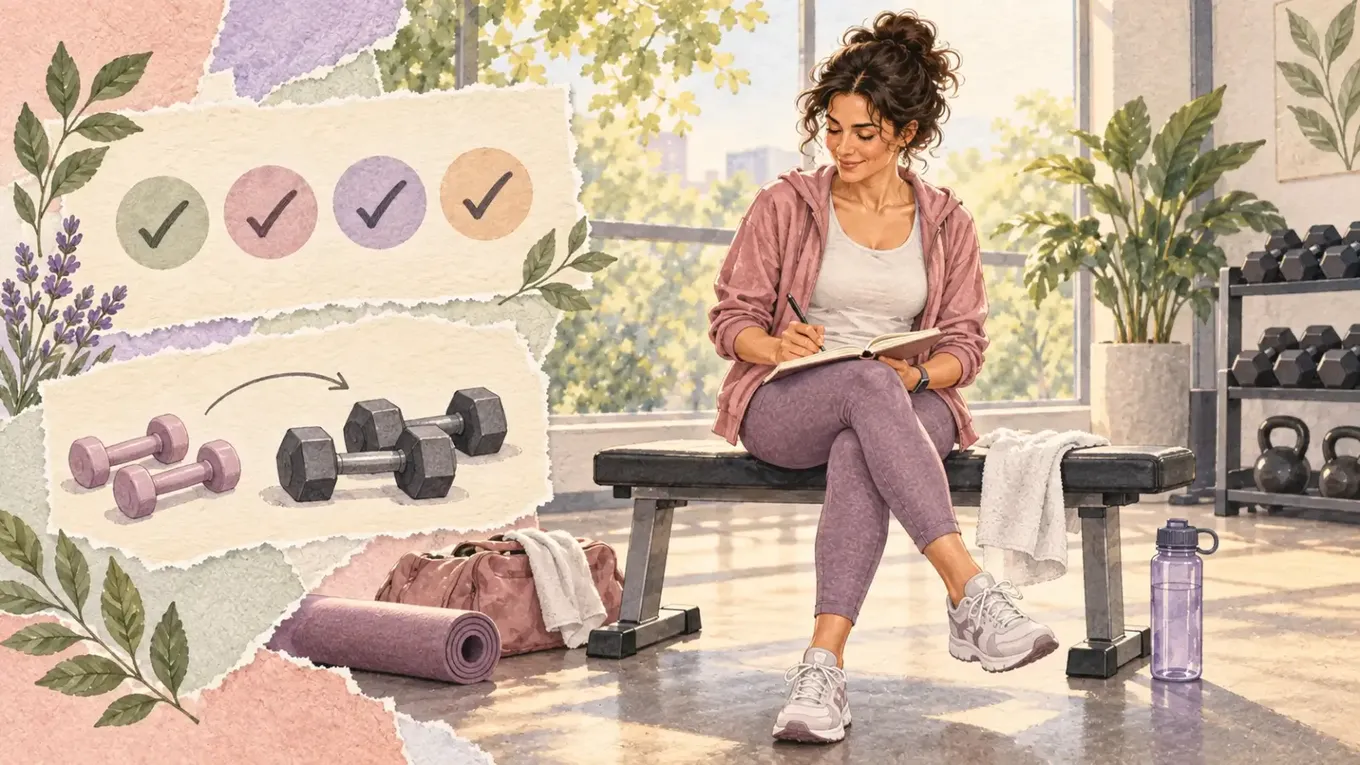
What to Do From the Moment You Walk In
A first workout is easier when it has a beginning, middle, and end.
- Warm up for 5–10 minutes. Walk, cycle, or use another easy cardio machine. You should feel warmer, not tired.
- Set up the first exercise. Adjust the machine before adding much resistance. If the setup is unfamiliar, ask a staff member.
- Do a light practice set. Try five to eight repetitions and make any seat or weight adjustment.
- Complete your working sets. Follow the day's table and rest as needed.
- Write down the weight and repetitions. A quick note prevents every session from becoming a guessing game.
- Leave with something in reserve. The first month is for building familiarity and repeatability, not auditioning for the hardest workout of your life.
According to Mayo Clinic's strength-training guidance, beginners should prioritize proper technique, increase resistance gradually, warm up before lifting, and stop an exercise if it causes pain.
Do Women Need a Different Beginner Workout?
Women do not need a mysterious set of pink-dumbbell rules. The core ingredients—training the major muscle groups, using progressive resistance, practicing good technique, and recovering between sessions—apply broadly.
A 2026 systematic review and meta-analysis of resistance training in adult women found improvements in strength and body composition across adulthood. Its authors concluded that general training guidance can apply to women, with individualization taking priority over rigid sex- or age-based distinctions.
Individual context still matters. Your menstrual cycle may change how energetic or comfortable a particular session feels. Perimenopause, menopause, pregnancy, postpartum recovery, pelvic-floor symptoms, previous injuries, medications, and health conditions may also change what is appropriate. Those differences call for adjustment or qualified support—not a universal “female workout” that assumes every woman's body and week are identical.
If your goal also includes changing body composition, our guide to body recomposition for women explains how training, food, recovery, and progress measures fit together without promising that one four-week block will transform your body.
Where Cardio Fits
Cardio and strength training do different jobs, and you do not need to turn one into punishment for the other.
The U.S. Physical Activity Guidelines for Americans advise adults to work toward 150 to 300 minutes of moderate aerobic activity each week, alongside muscle-strengthening activity on at least two days. They also emphasize that inactive people can begin with smaller amounts and build gradually.
In the first month, you could add one or two comfortable walks, bike rides, or other cardio sessions around the strength plan. Keep them easy enough that they do not make the next gym visit feel impossible. You are allowed to build one habit before optimizing six.
What If the Gym Is Busy—or You Miss a Day?
If a machine is occupied, choose the listed alternative or move to the next exercise and return later. The order is useful, but the workout does not collapse because the leg press has become someone's temporary office.
If you miss one session, continue with the next planned workout. You do not need to double up, squeeze six sessions into the following week, or restart from week one. Keep alternating A and B.
Mild muscle soreness can happen when an exercise is new. Sharp pain, joint pain, dizziness, faintness, chest pain, or unusual shortness of breath is different: stop exercising and seek appropriate medical advice. Persistent pain is not a progression strategy.
When a Generic Plan Stops Being Personal Enough
A table can give you a safe, uncomplicated place to begin. It cannot see your calendar, know which equipment your gym has, remember that you are returning after six months away, or adjust itself when three training days repeatedly become two.
Shelog Fitness Plans use your selected goal, training background, available time, preferred intensity, workout environment, and recovery needs to shape a more personalized routine. The plan is designed as general wellness and fitness guidance, with conservative progression for beginners; it is not medical care, physical therapy, injury rehabilitation, or pregnancy and postpartum programming. You can read the scientific basis and limitations behind Shelog Fitness Plans.
Build a personalized Fitness Plan around the life and equipment you actually have—download Shelog.
Beginner Gym Workout Questions
Is two or three gym days better for a beginner?
Both can work. Two full-body days meet the general muscle-strengthening frequency guideline and may be easier to recover from and maintain. A third day provides more practice and weekly training, provided you are recovering comfortably. Choose the schedule you can repeat.
Should a beginner use machines or free weights?
Either can be useful. Machines may make setup and balance simpler; dumbbells allow different movement options and are widely available. The 2026 ACSM evidence review found that equipment type did not consistently determine training outcomes. Use the option you can perform comfortably and progressively.
How long should a beginner gym workout take?
This plan may take roughly 30–45 minutes once you know the equipment, but there is no required duration. A busy gym, longer rest periods, and learning setup can make early sessions longer. Completing fewer movements with control is more useful than racing through the full table.
How heavy should women lift?
There is no single starting weight for women. Choose resistance that allows the target repetitions with stable technique and about two or three good repetitions left. Increase the load gradually after you can reach the top of the range in every set.
Will this four-week plan help me lose weight or “tone up”?
Resistance training can improve strength and contribute to changes in muscle and body composition, but this plan cannot guarantee weight loss or a visible change in four weeks. Body-weight change depends on a much wider pattern, including food intake, total activity, sleep, health, and time. Let your first month prove that you can build the routine—not that your body owes you a deadline.
The Takeaway
Your first gym plan does not need novelty. It needs a handful of movements you can learn, a schedule you can recover from, and a progression rule that does not ask you to prove yourself every time you walk through the door.
Begin with Workout A and Workout B. Use one set while you learn, build to two, and add repetitions before weight. Two consistent gym days beat a five-day plan that lives only in your notes app.
The goal of these four weeks is not to finish exhausted. It is to make the gym feel less like a room full of secrets—and more like somewhere you know what to do next.
Sources
- U.S. Department of Health and Human Services: Physical Activity Guidelines for Americans, 2nd Edition
- American College of Sports Medicine Position Stand: Resistance Training Prescription for Healthy Adults
- Systematic Review and Meta-Analysis: Resistance Training in Females Across the Lifespan
- Mayo Clinic: Weight Training—Do's and Don'ts of Proper Technique
This article is for general education and is not a substitute for personal medical or nutrition advice.
More From Shelog
Keep Reading
Take Shelog with you
Take Shelog with you
Shelog turns the ideas in this article into a simple daily diary—food, mood, movement, and weight in one calm place.