

More Reps or More Weight for Fat Loss? What Actually Matters
Should you lift heavier or do more reps for fat loss? Learn what each approach changes, how to progress safely, and why neither is a magic fat-burning range.
Shelog Editorial
Reviewed for clarity and care

You finish 15 dumbbell reps and your arms are burning. A few steps away, someone lifts a heavier pair for six. If fat loss is your goal, which approach should you choose?
The answer is less dramatic than that burning feeling suggests.
Neither more repetitions nor more weight is automatically better for fat loss. Losing body fat depends mainly on maintaining an energy deficit over time. Resistance training has a different—and very useful—job: it helps you become stronger and can help preserve muscle while you lose weight. Heavier loads tend to be better for building maximal strength, while a wide range of loads can support muscle growth when the work is sufficiently challenging.
So the choice is not “Which rep range melts fat?” It is “Which training approach lets me work hard, progress, recover, and keep using good technique?”
Fat Loss and Rep Range Are Two Different Decisions
A set of eight squats and a set of 15 squats feel different. They challenge your muscles and cardiovascular system differently, and they may not use exactly the same amount of energy during that session. But those differences do not create a special switch that makes one repetition range remove body fat from your waist, hips, or arms.
The CDC explains that weight loss results from an energy deficit: over time, the energy your body uses exceeds the energy you consume. Physical activity contributes to that equation, but the number of repetitions in one exercise is only a very small piece of a much larger pattern.
Resistance training still matters during fat loss. A 2025 systematic review and meta-analysis compared dietary weight loss plus resistance exercise with dietary weight loss alone in adults with overweight or obesity. Adding resistance exercise did not produce a meaningful additional difference in total body weight, but it helped protect fat-free mass, increased fat-mass loss, and improved strength. In other words, the scale did not tell the whole story.
That is why it makes more sense to train for strength and muscle than to chase the largest calorie number on a watch.
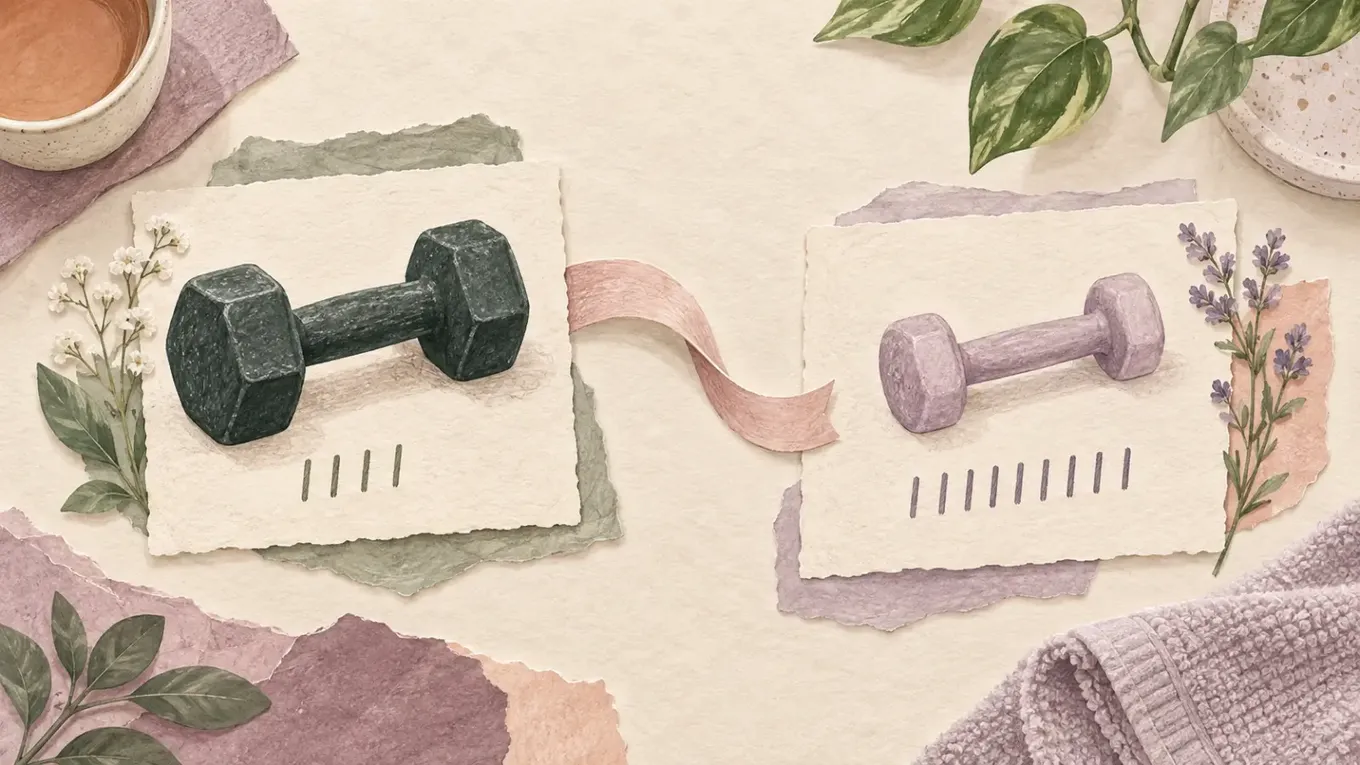
Heavier Weight or More Reps: What Each Is Good At
“Heavy” and “light” are relative. A weight that feels light for your first repetition may feel decidedly less friendly by repetition 14. A weight that is heavy for one person may be another person’s warm-up.
Instead of judging a workout by the number on the dumbbell, match the training style to what you want it to do.
| If your priority is… | A practical emphasis | Why |
|---|---|---|
| Building maximal strength | Relatively heavier loads and fewer controlled repetitions | Practicing against heavier resistance is more specific to getting better at lifting heavier resistance |
| Building or preserving muscle | A range of moderate-to-heavier or lighter challenging loads | Muscle growth can occur across different loads when training is progressive and the sets are sufficiently demanding |
| Learning a new movement | A load that allows consistent, comfortable technique | Skill comes before adding weight or grinding through extra repetitions |
| Training around limited equipment | More repetitions, slower controlled movements, or a harder variation | These can make a lighter available load more challenging |
| Managing an exercise that feels uncomfortable when heavily loaded | A lighter load, a comfortable repetition range, or a different exercise | No specific lift or repetition range is compulsory |
The latest American College of Sports Medicine position stand synthesized 137 systematic reviews involving more than 30,000 participants. It found that progressive resistance training improves strength, muscle size, power, endurance, and physical function. Heavier loads—around 80% or more of a one-repetition maximum in the research—favored maximal strength, but high effort could be achieved with different loads.
That does not mean a beginner needs to test a one-repetition maximum or lift at that percentage. It means the weight on the bar matters more when the specific goal is becoming good at lifting very heavy weights. For general fitness and muscle support, there is much more room to choose equipment and repetition ranges that suit you.
A large 2023 network meta-analysis of resistance-training prescriptions reached a similar conclusion: all the training prescriptions it examined improved strength and muscle growth compared with no exercise. Higher-load programs ranked highest for strength, while muscle growth was promoted across prescriptions.
Why High Reps Feel Like They Must Be Burning More Fat
High-repetition sets often come with a strong local burning sensation, a faster heartbeat, and more breathlessness. Those are real experiences. They are simply not a body-fat meter.
That burning feeling comes from what is happening in the working muscle during a demanding set. Sweat helps regulate your body temperature. Neither measures how much body fat you have lost.
You might use more energy in one high-rep session than in a shorter low-rep session. But change the sets, rest periods, exercises, pace, or length of either workout and the comparison changes. One set’s burn cannot tell you what will happen to your body fat over the coming weeks.
Research does support resistance training as part of a body-fat strategy. A systematic review of healthy adults found that resistance training reduced body-fat percentage and fat mass compared with no exercise. The review did not establish one magical repetition range. The useful signal was doing resistance training consistently—not turning every set into a contest for the most dramatic sensation.
“Toning” Is Not a Separate Kind of Muscle
Women are often told to use tiny weights for endless repetitions to “tone” without becoming bulky. It is an unhelpful way to turn a practical training choice into a fear about how your body might look.
Muscle does not have separate “toned” and “bulky” settings. The appearance people call toned reflects a combination of muscle, body-fat level, genetics, and other factors. Building a substantial amount of muscle takes time and repeated training; picking up a challenging dumbbell will not transform your body overnight.
You also do not need to lift the heaviest possible weight to make a workout legitimate. Machines, dumbbells, bands, body weight, lighter loads, and heavier loads can all be useful. The better question is whether the exercise feels stable, becomes challenging within the planned range, and can progress without your technique unraveling.
If your broader goal is to lose fat while maintaining or gaining muscle, our guide to body recomposition for women explains why scale weight, strength, measurements, and recovery may not all change at the same pace.
Use Repetitions First, Then Add Weight
For many beginners, the simplest answer to “more reps or more weight?” is to increase one, then the other.
Choose a comfortable repetition range for an exercise, such as 8–12 repetitions. Start with a weight you can control throughout the movement and finish while feeling that you could probably perform another two or three good repetitions.
Then use this progression:
- Keep the same weight and gradually add repetitions within the range.
- When you can complete the top of the range across all planned sets with consistent technique, increase the weight by the smallest useful amount.
- Let your repetitions return toward the lower end of the range.
- Build them up again over future sessions.
Suppose you are doing two sets of dumbbell rows at 8–12 repetitions. One week you complete 10 and 9. Later, you reach 12 and 12 with the same controlled movement and still have a little capacity left. Move to the next manageable dumbbell. If you now complete 9 and 8, nothing has gone backward; you have started a new round of progression.
You do not need to improve every workout. Sleep, stress, menstrual symptoms, perimenopause, illness, and ordinary life can all affect performance. Some days the sensible choice is to repeat the same weight, do fewer repetitions, or use an easier variation. Progress is the pattern across weeks, not a demand that every session set a personal record.
If you need a full routine rather than a progression rule, use our four-week beginner gym workout plan for women. It includes two- and three-day schedules, exercise alternatives, and a conservative way to start.

How to Choose During a Fat-Loss Phase
During fat loss, use the following order of priorities:
1. Keep the movement recognizable
If adding weight makes you shorten the movement, swing the load, hold your breath throughout, or throw your whole body into a small arm exercise, it is probably too much weight for that set.
2. Make the set challenging enough to matter
A very light set that ends because you became bored is different from a lighter set that becomes genuinely challenging while your technique stays controlled. You do not have to reach complete muscular failure. The 2026 ACSM review found that training to momentary fatigue did not consistently determine results for healthy adults.
3. Leave room to recover and come back
More is not automatically better if a workout leaves you too sore or exhausted for the rest of your week. Choose a challenge you can recover from and repeat.
4. Watch performance, not only workout calories
Record the exercise, load, repetitions, and how the sets felt. If your technique is stable and your repetitions or load gradually improve—or at least remain reasonably steady during a calorie deficit—that is more informative than the calorie estimate on a watch.
Also watch the broader picture: recovery, energy, menstrual changes, strength trends, clothing fit, measurements if you use them, and a multiweek weight trend. No single signal can perfectly separate fat, muscle, water, and normal daily variation.
A Sensible Default for Beginners
If you are healthy, new to resistance training, and want a simple place to begin, you do not need to organize your entire program around “fat-loss reps.”
- Train your major muscle groups on at least two nonconsecutive days per week as a practical starting structure.
- Use familiar exercises and a moderate range such as 8–12 repetitions for many movements, with somewhat higher repetitions where they feel more comfortable.
- Finish most sets with roughly two or three controlled repetitions still possible.
- Add repetitions first and small amounts of weight second.
- Choose a different exercise if a movement causes pain or never feels stable after you have received appropriate instruction.
The U.S. Physical Activity Guidelines for Americans recommend muscle-strengthening activity involving all major muscle groups on at least two days each week, alongside aerobic activity. That is a general health baseline, not a personalized prescription.
This article is for general fitness education, not injury rehabilitation or medical care. Stop exercising and seek appropriate medical advice for chest pain, faintness, unusual shortness of breath, or sharp or persistent pain. Ask a qualified healthcare or exercise professional for individualized guidance if you are pregnant, recently postpartum, returning after an injury, managing a condition that affects exercise, or unsure whether resistance training is appropriate for you.
Build the Plan Around More Than a Rep Number
The plan that works for you has to fit your experience, schedule, equipment, and recovery—not just a recommended rep range.
Shelog Fitness Plans use the goal, training background, available time, preferred intensity, workout environment, and recovery needs you select to shape a more personalized routine. You can also record workouts alongside food, mood, water, and weight, giving you more context than a single “calories burned” number. The plans are general wellness and fitness guidance, not medical care, physical therapy, injury rehabilitation, or pregnancy and postpartum programming. You can review the scientific basis and limitations behind Shelog Fitness Plans.
Build a plan that progresses with your real life—download Shelog.
Sources
- American College of Sports Medicine: Resistance Training Prescription for Muscle Function, Hypertrophy, and Physical Performance in Healthy Adults
- British Journal of Sports Medicine: Resistance Training Prescription for Muscle Strength and Hypertrophy in Healthy Adults
- BMJ Open Sport & Exercise Medicine: Resistance Exercise During Dietary Weight Loss
- Sports Medicine: The Effect of Resistance Training on Body-Fat Measures in Healthy Adults
- CDC: Physical Activity and Your Weight and Health
- U.S. Department of Health and Human Services: Physical Activity Guidelines for Americans
This article is for general education and is not a substitute for personal medical or nutrition advice.
More From Shelog
Keep Reading
Take Shelog with you
Take Shelog with you
Shelog turns the ideas in this article into a simple daily diary—food, mood, movement, and weight in one calm place.