

Stages of Noticing Weight Loss: What Changes First?
When does weight loss become noticeable? Learn how scale changes, clothing fit, and your cycle can affect what you see—and how to track progress fairly.
Shelog Editorial
Reviewed for clarity and care

Imagine pulling on your usual jeans before heading out. The waistband seems a little easier. Later, the scale barely budges. You catch your reflection and wonder: is anything actually changing?
There is no fixed week or number of pounds at which weight loss becomes noticeable. The scale, your clothes, and the mirror can tell slightly different stories. You may notice one change well before another.
If you have been searching for the “stages of noticing weight loss,” you are probably looking for something more useful than a before-and-after photo: a sense of what to expect, and how to tell whether your efforts are adding up.
Think of the stages below as possible experiences along the way. They can overlap, arrive in a different order, or be so subtle that you only recognize them when you look back.
The scale may be the first to move
Perhaps the first few readings drop and you start doing the mental math: if every week goes like this…
That first week can be a misleading starting point. Your body stores carbohydrate as glycogen, along with water. Using some of those stores can contribute to a quick early decrease, as described in the Mayo Clinic explanation of weight-loss plateaus.
A gentler pace after that early drop does not, by itself, mean something has gone wrong. There is no need to chase the first week's number by restricting carbohydrates or fluids.
For context, the CDC describes gradual weight loss of about 1–2 pounds a week as an approach associated with better weight maintenance than faster loss. That is general guidance, not a minimum you must achieve or a promise about when you will look different.
Then an everyday outfit might feel different
The first change you care about might be wonderfully ordinary: sitting down in your jeans feels a little more comfortable, or a familiar top hangs differently. You can note that without immediately working out how many pounds it represents.
Clothes and mirrors are imperfect witnesses. Fabric stretches; lighting and posture change. Neither measures body fat, but a fair comparison can still give you something useful to look back on.
If you want to compare clothing fit, use the same item in a similar condition. Stretchy leggings after a day's wear and jeans just out of the dryer are poor comparisons. Write something specific, such as “the same waistband feels less snug when seated,” instead of trying to assign yourself a new size from memory.
If you like progress photos, give them a little consistency: the same spot, similar light, the same outfit. Pick a time to revisit them instead of inspecting yesterday against today. And if photos leave you picking yourself apart, skip them. Your camera roll does not need to become another obligation.
Body composition also matters. UC Davis Sports Medicine explains that people with the same height and weight can have different proportions of muscle and fat. A scale reading alone cannot describe those proportions. Our guide to body recomposition for women explores that separate goal in more detail.
Your period can make the picture less clear
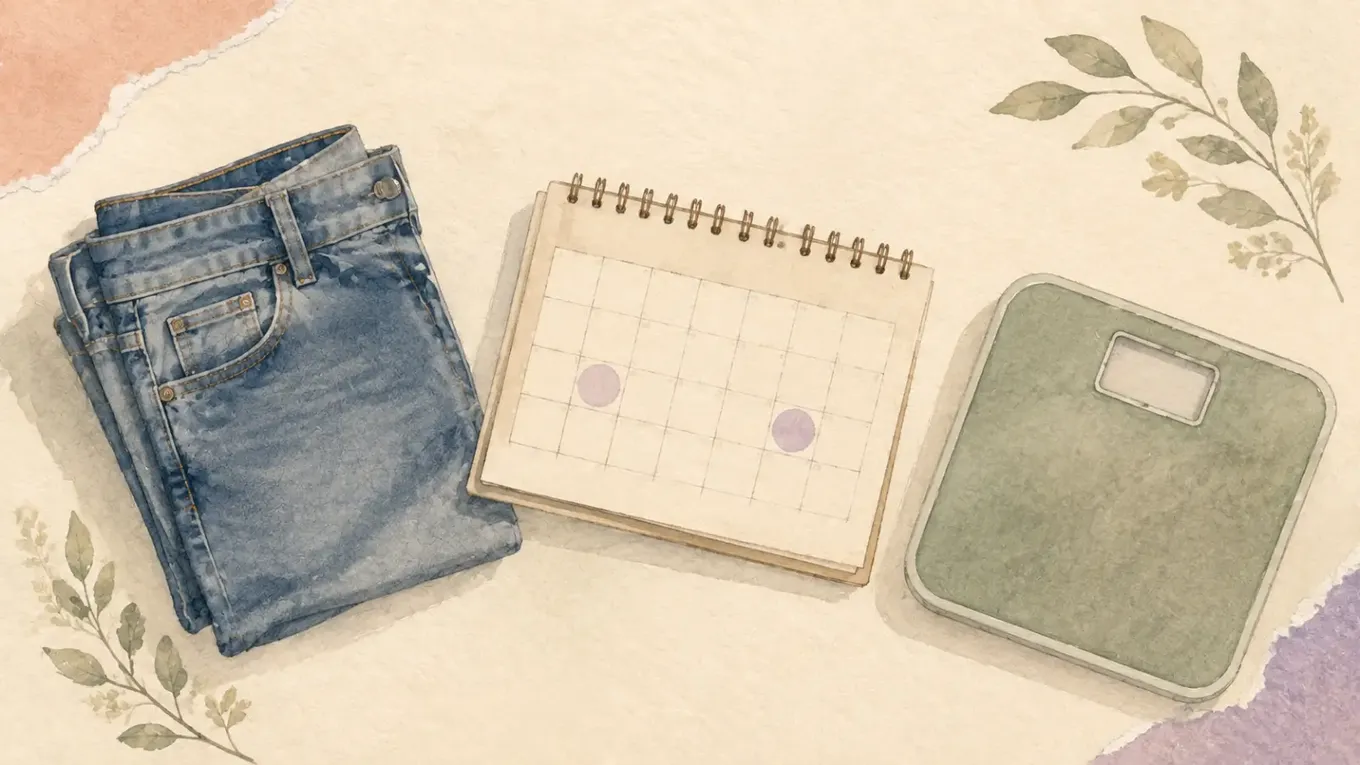
Now imagine that those more comfortable jeans feel snug again around your period. Before rewriting your whole plan, check the calendar alongside the scale. Menstrual water changes are one reason a short comparison can be confusing.
In a 2023 study of 42 women, body weight was about 0.45 kg higher during menstruation than during the comparison phase, largely alongside increased extracellular water. This was a small study: its average is not a prediction of your own fluctuation, and it does not explain every weight increase.
If you already track your cycle, try looking at readings from similar points in successive cycles as well as your overall trend. That gives the comparison more context. With an irregular cycle, a simple note about bleeding is enough; there is no need to squeeze your experience into a neat 28-day calendar.
How much weight do you need to lose before others notice?
There is a tempting idea that one particular number unlocks the moment everyone notices. The evidence reviewed for this guide does not give us that number. “Everyone notices after 10 pounds” makes a tidy headline, but a poor personal deadline.
Other people's comments are especially difficult to interpret. Someone may notice a change and avoid mentioning your body. Someone else may comment because your clothes or hairstyle look different. Silence is not a measurement, and you do not need a compliment to validate a record of progress.
Give yourself a check-in, not a daily inspection

You can keep this small. Choose one or two observations that help you, then set aside a few minutes to look back at them. The ideas below are a practical recording routine, not a timetable for when your body should change.
| Observation | Keep the comparison fair | Write down |
|---|---|---|
| Weight, if you choose to track it | Use the same scale and similar conditions | Date and reading; look across multiple observations |
| Clothing fit | Use the same garment in a similar condition | One concrete note about fit |
| Optional photo | Keep lighting, distance, and posture similar | The date; do not infer a body-fat percentage |
| Everyday activity | Compare the same walk or exercise | Whether it felt easier, similar, or harder |
| Context | Note relevant circumstances | Menstrual bleeding or a change in routine |
When you look back, describe what happened before deciding what to change. “My weight readings are gradually lower, but my clothes feel the same” is useful. So is “the walk to the station feels easier.” The second observation tells you about that activity, rather than proving fat loss; it is still worth noticing.
You do not have to turn every small change into a verdict about your body.
If the main problem is a weight trend that seems unusually slow, use our two-week weight-loss check to review the context. If your longer-term plan needs a fresh look, our maintenance calorie calculator can estimate daily energy needs from your current details and activity level. Treat it as a starting estimate for maintaining weight, not a weight-loss prescription or a countdown to visible results. An appearance deadline alone is not a reason to keep cutting food.
When to get support
If you keep losing weight without trying, arrange a medical appointment rather than treating it as welcome progress. The NHS advises assessment for unexplained weight loss, especially when other symptoms are present.
If tracking your appearance or weight is making meals stressful or encouraging increasingly strict food rules, step back from the tracking routine and discuss it with a qualified healthcare professional. This guide is for understanding observations, not deciding whether weight loss is appropriate for you.
Questions about noticing weight loss
Will I see a difference after two weeks?
You might, but two weeks is not a reliable appearance deadline. Early scale changes can include water, and photos or clothing fit do not measure fat loss directly. Use comparable observations instead of a countdown.
Are there separate female stages of weight loss?
The evidence cited here does not establish a fixed female sequence of visible changes. Menstrual water fluctuations are one reason to include cycle context, rather than assign every woman the same weekly milestones.
Does a smaller waist with the same weight mean I gained muscle?
It does not prove muscle gain. A tape measure and scale describe different things, and measurement conditions matter. Body composition requires more information than those two readings alone.
Is it a problem if nobody has noticed?
Their reaction cannot tell you whether your health or weight trend has changed. Compare your own records and, where relevant, the goals you agreed on with your healthcare professional.
Leave a few notes for your future self
A few weeks from now, it may be easier to remember an especially frustrating weigh-in than the ordinary days around it. Leave yourself a little more to work with: a meal, a workout, a mood, a weight entry.
You can keep those everyday records together in Shelog, then return to them when you want to review how things have been going. A useful entry can be as simple as what happened today. It does not need a dramatic before-and-after.
Sources
- Mayo Clinic: Getting past a weight-loss plateau — glycogen, water, and changes in the rate of weight loss.
- CDC: Steps for Losing Weight — general guidance on gradual weight loss.
- UC Davis Sports Medicine: Body Composition — why body weight and body composition are different measures.
- Changes in body weight and body composition during the menstrual cycle, 2023 — a small study of menstrual-cycle weight and water changes.
- NHS: Unintentional weight loss — when unexplained weight loss needs medical assessment.
This article is for general education and is not a substitute for personal medical or nutrition advice.
More From Shelog
Keep Reading
Take Shelog with you
Take Shelog with you
Shelog turns the ideas in this article into a simple daily diary—food, mood, movement, and weight in one calm place.