

Macro Percentages for Weight Loss: A Guide for Women
There is no single best macro split for weight loss. Learn how women can turn broad percentages into flexible protein, fat, and carb targets.
Shelog Editorial
Reviewed for clarity and care

One tab says 40/30/30. Another insists on 40/40/20. A third promises that 50/25/25 is the answer you have been missing. Search for macro percentages for weight loss and, within minutes, your dinner can start to feel like an algebra exam.
Here is the more reassuring truth: there is no single protein, fat, and carbohydrate split that research has shown to be best for every woman trying to lose weight. A ratio can give your meals some structure, but it cannot account for your total energy needs, activity, food preferences, health, or whether you would still want to eat that way on a busy Wednesday.
The most useful macro split is not the one with the neatest numbers. It is one that supports adequate nutrition and fits your real life.
So let us make the numbers useful—and then let you get back to eating lunch while it is still warm.
What Are Good Macro Percentages for Weight Loss?
Protein, fat, and carbohydrate are macronutrients—the nutrients your body needs in relatively large amounts. Think of them as three adjustable dials, not a secret passcode. They all have important jobs, and they also provide energy:
- protein provides 4 calories per gram
- carbohydrate provides 4 calories per gram
- fat provides 9 calories per gram
For healthy adults, the US Dietary Reference Intakes give broad Acceptable Macronutrient Distribution Ranges, often shortened to AMDRs:
- carbohydrate: 45–65% of daily calories
- fat: 20–35% of daily calories
- protein: 10–35% of daily calories
These ranges are useful boundaries, not a weight-loss formula. The European Food Safety Authority makes the same distinction: dietary reference values are science-based population references, not individual nutrient goals.
In other words, the ranges are more like the edges of a map than a pin dropped on your perfect destination. That is why a precise answer like “everyone should use 40% carbohydrate, 30% protein, and 30% fat” goes further than the evidence allows.
Is 40/30/30 a Good Macro Split?
A 40/30/30 split—40% carbohydrate, 30% protein, and 30% fat—can be a perfectly workable pattern for some people. Think of it as an outfit that may fit nicely off the rack, not a uniform every woman has to wear. It is not automatically better for weight loss than another balanced split.
In the 12-month DIETFITS randomized clinical trial, 609 adults followed either a healthy low-fat or healthy low-carbohydrate approach. The groups ended up eating meaningfully different macro distributions, yet their average weight loss was not significantly different. An earlier NIH-funded trial comparing four reduced-calorie diets also found meaningful average weight loss regardless of which macronutrient the diet emphasized.
This does not mean macros never matter. A particular balance may affect how satisfied you feel, what meals you enjoy, how you train, and how easy the plan is to repeat. It means the ratio is a tool, not a hidden switch that determines the result by itself.
Why Percentages Can Be Misleading
A percentage only makes sense in the context of total calories. This is the part those beautifully color-coded social posts often forget.
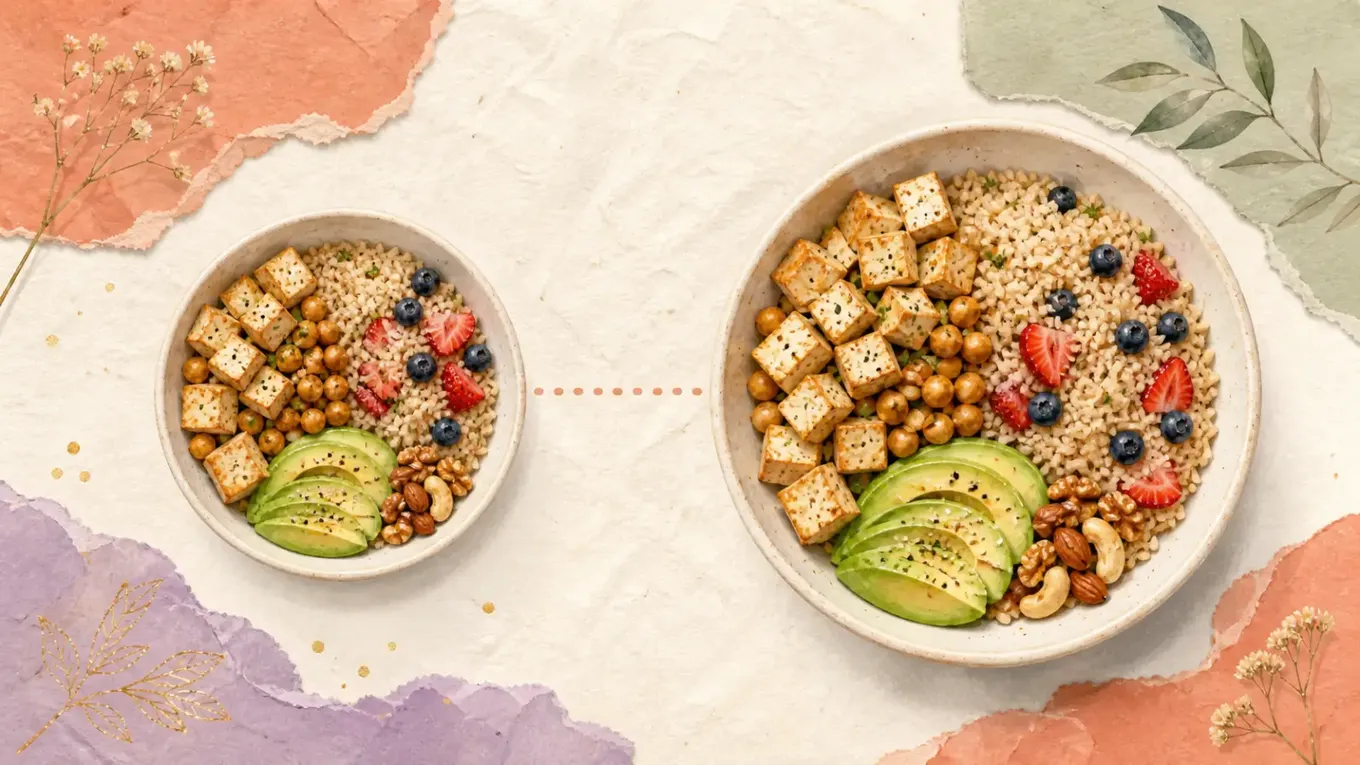
Imagine two women both set protein at 25%:
- at 1,400 calories, 25% protein is 350 calories, or about 88 grams
- at 2,400 calories, 25% protein is 600 calories, or 150 grams
Same percentage, very different plate. This is one reason it is often more helpful to think about protein in grams first, then see what percentage it becomes within your overall estimate.
Percentages can also hide food quality. Two days can land on the same macro split while providing very different amounts of fiber, vitamins, minerals, and variety. Current US Dietary Guidelines emphasize whole, nutrient-dense foods and limiting highly processed foods. A pie chart cannot tell you whether lunch was colorful, satisfying, or something you actually enjoyed.
A More Useful Way to Set Your Macros
You do not need to calculate everything before your next grocery trip. Work through these decisions in order.
1. Begin with an energy estimate, not a borrowed calorie target
Your macro grams depend on the total energy in the plan. Shelog's maintenance calorie calculator can give you a starting estimate based on your details and activity.
Treat the result as an estimate, not a prescription. The NIDDK Body Weight Planner likewise uses individual information to model possible changes over time and explains that its results have limits. A calorie target borrowed from a friend, an influencer, or your own life five years ago cannot know your health history or what your days look like now.
2. Consider protein in grams
Protein can help meals feel substantial and supplies the building blocks used by body tissues. During energy restriction, research suggests that protein above the basic adult recommended allowance may modestly reduce lean-mass loss on average. The effect is useful, but not magical: a Purdue University systematic review found a small average benefit, not proof of one ideal percentage—or a reason every meal has to become an audition for “most protein possible.”
Shelog's protein intake calculator can help you explore an estimated gram range. Your appropriate amount may differ if you are pregnant, breastfeeding, highly active, older, or managing a condition that affects nutrition. A registered dietitian or clinician can individualize it.
3. Let fat and carbohydrate reflect your needs and preferences
Once you have considered protein, there is usually room to arrange fat and carbohydrate in more than one reasonable way. Your dinner does not need to choose a team.
You might prefer more carbohydrate because you enjoy rice, bread, fruit, or endurance training. You might prefer somewhat more fat because foods such as nuts, seeds, olive oil, avocado, eggs, or dairy help meals feel satisfying. Perhaps pasta makes a weeknight easier; perhaps avocado toast is a small daily joy. Neither preference is a character test.
The fat intake calculator and carbohydrate intake calculator can help you see how broad ranges translate into grams. Keep the AMDRs in view, but do not treat the very edge of a population range as a personal challenge to hit.
4. Convert the percentages into grams
Time for the brief calculator moment—we promise it is friendlier than it looks. Suppose someone has already chosen an illustrative 1,800-calorie plan with 25% protein, 30% fat, and 45% carbohydrate. The calculation would be:
- protein: 1,800 × 0.25 = 450 calories; 450 ÷ 4 = about 113 grams
- fat: 1,800 × 0.30 = 540 calories; 540 ÷ 9 = 60 grams
- carbohydrate: 1,800 × 0.45 = 810 calories; 810 ÷ 4 = about 203 grams
This is a math example, not a recommended split or calorie target. Its purpose is simply to take the percentages out of the clouds and show what they mean in grams.
Do Women Need a Different Macro Split?
“Woman” is not a nutrition setting with one preset. Sex is one input in estimating energy needs, but women do not share one special macro ratio.
Needs can change with body size, activity, age, pregnancy, breastfeeding, health conditions, medicines, and personal goals. A marathon-training week and a desk-bound recovery week may not feel the same. Neither will every season of a woman's life.
Menopause does not automatically create a scientifically established “hormone-balancing” macro percentage either. The American College of Obstetricians and Gynecologists describes a balanced diet as a combination of protein, carbohydrate, and fat; it does not prescribe one menopause-specific split. Be cautious when a plan mentions women's hormones and then—almost like magic—produces one exact ratio for everyone.
What may deserve more attention is whether the plan provides enough total energy and nutrition for your life. Missed or irregular periods, persistent fatigue, dizziness, repeated injuries, or declining performance are not signs to make your macros stricter. They are reasons to speak with a qualified health professional.
How to Tell Whether Your Macro Targets Fit
Give the plan enough time to become a pattern, then review more than the scale. Use a couple of ordinary weeks—not a fantasy week in which every meal is prepped, every workout happens, and nobody invites you out for dinner.

Ask:
- Can I make meals I genuinely like with these targets?
- Do meals usually keep me comfortable until the next planned meal or snack?
- Do I have enough energy for work, care responsibilities, and exercise?
- Am I regularly missing a target because the target is awkward, or because one routine needs support?
- Is tracking giving me useful information, or making me anxious and rigid?
Change one part at a time. If protein is consistently difficult, look at one meal rather than rebuilding the whole day. Breakfast may need a little help; breakfast does not require a complete nutritional identity crisis. If training feels flat, review total energy, carbohydrate, sleep, and recovery before assuming you need a stricter split. If the plan feels good but the scale is noisy, compare longer trends before changing it.
Digital self-monitoring can help people notice patterns, but it is not a guarantee. A systematic review led by researchers at Stanford and Duke found that greater engagement with digital self-monitoring was associated with weight loss in many behavioral interventions. It also found that sustained engagement was difficult.
That is a useful design rule for your own plan: the record that helps is the one you can continue without accidentally turning nutrition tracking into your second job.
You Do Not Have to Track Every Gram
Macro tracking is optional. You could use it briefly to learn what your usual meals contain, check a few repeat meals, or review protein without setting targets for everything else. You are allowed to learn from the numbers without promising to log every blueberry forever.
If detailed tracking makes eating more anxious, guilty, or compulsive, step back. NHS guidance recommends speaking with a health professional before making weight-loss changes if you have an eating disorder or a history of one, and it is clear that calorie counting is not the only way to lose weight.
Use calorie information as context, and keep a food diary that helps you notice patterns without judging individual meals.
How Shelog Can Make the Pattern Easier to See
Shelog brings food, mood, workouts, water, and weight into one diary, so you can look at how a macro plan fits the whole day—not only whether three numbers turned green.
When you need a quick estimate, Shelog's food calorie checker can use a meal photo to estimate calories and macros. Photo-based results depend on what is visible and should be treated as estimates, especially for portions, sauces, and mixed dishes.
Use the record to notice repeatable patterns: the breakfast that keeps you comfortable through a long meeting, the takeaway lunch that is always hard to estimate, or the workout day when an afternoon snack makes the evening feel much better.
Some days the estimate will be tidy. Some days dinner will be shared plates, three sauces, and no realistic way to know every gram. Both days can still teach you something. The goal is not to earn a perfect score. It is to make the next useful decision easier.
Keep your meals and the life around them together with Shelog.
When to Ask for Individual Advice
Generic macro guidance is not a substitute for personal care. Talk with a registered dietitian, doctor, or other qualified professional if you:
- are pregnant, breastfeeding, under 18, or training at a high level
- have diabetes, kidney disease, digestive disease, or another condition affected by nutrition
- take medicine that affects appetite, blood glucose, digestion, or weight
- have a current or previous eating disorder
- have missed periods, repeated injuries, marked fatigue, dizziness, or rapid unexplained weight change
A professional can decide whether weight loss is appropriate and help set targets around your health—not around a trending ratio.
The Takeaway
There is no best macro percentage for every woman trying to lose weight. A 40/30/30 split may be workable, but it is not a universal answer hiding in plain sight.
Start with an individualized energy estimate. Think about protein in grams. Keep fat and carbohydrate flexible enough to support your preferences and activity. Then review whether the plan works in ordinary life.
Good macro targets should make your choices clearer, your meals easier to build, and your progress less mysterious. They should not make your life smaller—or make you fear the pasta night you were looking forward to.
Sources
- USDA National Agricultural Library: Macronutrients
- USDA Food and Nutrition Information Center
- European Food Safety Authority: Dietary Reference Values Finder
- National Institute of Diabetes and Digestive and Kidney Diseases: Body Weight Planner
- Office of Disease Prevention and Health Promotion: Current Dietary Guidelines
- JAMA: DIETFITS Randomized Clinical Trial
- New England Journal of Medicine: Diets With Different Fat, Protein, and Carbohydrate Compositions
- Advances in Nutrition: Protein Intake and Lean Body Mass
- British Journal of Nutrition: Higher-Protein Diets and Weight Management
- Obesity: Self-Monitoring via Digital Health in Weight Loss Interventions
- NHS Better Health: Calories and Weight Loss
- American College of Obstetricians and Gynecologists: Healthy Eating
This article is for general education and is not a substitute for personal medical or nutrition advice.
Take Shelog with you
Take Shelog with you
Shelog turns the ideas in this article into a simple daily diary—food, mood, movement, and weight in one calm place.