

How Much Protein Do You Need on a GLP-1?
Understand protein targets during GLP-1 treatment, why grams and percentages differ, and how food records can support a conversation with your care team.
Shelog Editorial
Reviewed for clarity and care

You sit down to lunch, take a few bites, and find that you are already full. If your appetite has changed during GLP-1 treatment, the advice to “get more protein” may sound straightforward—until you try to fit it into your day.
There is no single protein target for everyone taking a GLP-1. A 2025 joint nutrition advisory describes 80–120 grams a day as a practical option during active weight loss and discusses proposed weight-based targets of 1.2–1.6 grams per kilogram per day. These are references to discuss with your prescriber or dietitian, not an automatic prescription. Read the joint advisory.
Before changing your meals, it helps to settle two questions: how much protein is appropriate for you, and how much are you usually eating?
Why Do You Keep Seeing Different Protein Numbers?
Some advice gives a fixed number of grams. Other advice asks you to multiply your weight by a factor. Those approaches do not necessarily produce the same answer.
The advisory notes uncertainty about which weight to use in people with obesity: current weight, an adjusted or ideal weight, or fat-free mass. Current weight can overestimate requirements, and there is no consensus on the best approach. Joint advisory, protein guidance.
So if one page uses your current weight and another uses a goal weight, you are not comparing like with like. Pounds and kilograms can add another layer of confusion.
Rather than averaging the answers, ask your care team:
- What daily protein target makes sense for me?
- If it is weight-based, which weight should I use?
- When should we review it as my treatment, intake, or activity changes?
You do not need to recalculate after every change on the scale. If you already have an individualized nutrition plan, stick with it unless your clinician recommends a change.
When Do You Need More Individual Guidance?
Kidney disease is an important example. NIDDK explains that protein needs can change with chronic kidney disease, and the amount and sources should be worked out with your healthcare professional or dietitian. Dialysis can change those needs again.
If you have kidney disease or have been given a protein restriction, do not adopt a higher target from a general GLP-1 article without checking it first.
If you cannot comfortably eat enough to reach your target, mention that at your next review, too. Your plan may need adjusting to what you can manage.
Protein Grams and Protein Percentages Answer Different Questions
Grams tell you how much protein is in the food you record. A percentage tells you its share of calories. You need the context of total intake to connect the two.
Here is a calculation example—not a calorie recommendation:
| Recorded intake for one day | Calories from protein at 20% | Approximate protein grams |
|---|---|---|
| 1,200 calories | 240 calories | 60 g |
| 1,800 calories | 360 calories | 90 g |
The percentage is identical, but the amount of protein is not. The calculation uses the standard estimate of four calories per gram of protein; our guide to macro percentages explains the distinction in more detail.
A protein percentage can look reassuring even when the grams fall short of your agreed target. Eating less of everything else can raise that percentage without adding any protein at all.
For several days of records, do not multiply an average percentage by an average calorie intake and assume you have recovered the exact average grams. Review the gram entries themselves when that is the question you need to answer.
Take a Look at Your Usual Meals
Once you have an agreed target, a food record can help you see how it fits into your usual day. You do not need to start by buying new products or replacing everything you enjoy.
Look at the foods and portions you actually ate. For packaged food, check protein grams alongside the serving size. The FDA's label guide explains that nutrient amounts normally refer to the listed serving; that serving is not a recommendation of how much you should eat.
If you ate half the listed serving, the full-serving protein number will not describe your intake. The same applies when an app entry describes a whole meal you only partly finished.
As you look back, you may notice something worth changing: perhaps breakfast rarely includes a protein source, or you often leave the chicken at lunch because it no longer appeals to you. A record can help you spot those habits, though it cannot diagnose a deficiency.
An incomplete diary needs context, too. A day with only breakfast recorded cannot tell you what happened at lunch and dinner. Make a note of missing entries rather than reading the total as a complete account.
How Shelog Helps You Look Beyond a Single Day
One day's food record may not tell you much about your usual routine. Shelog's new food analysis helps you look back across recorded days and see recurring mixes of protein, carbohydrate, and fat.
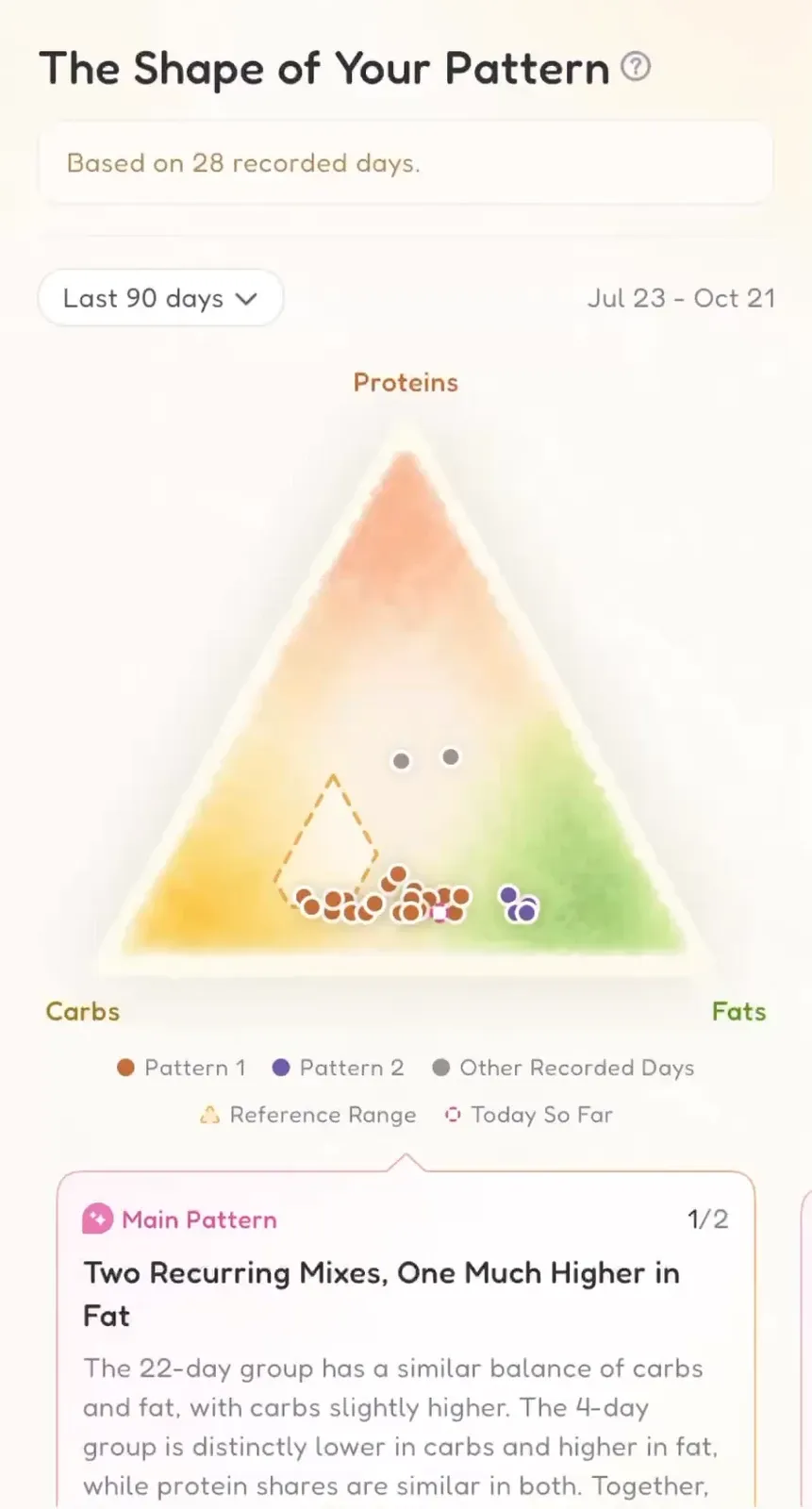
In this example, the chart groups days with similar macronutrient mixes. The explanation alongside it helps you compare those groups before going back to the meals behind them.
The screen also offers a breakfast, lunch, and dinner comparison, alongside average calorie shares from each macronutrient.
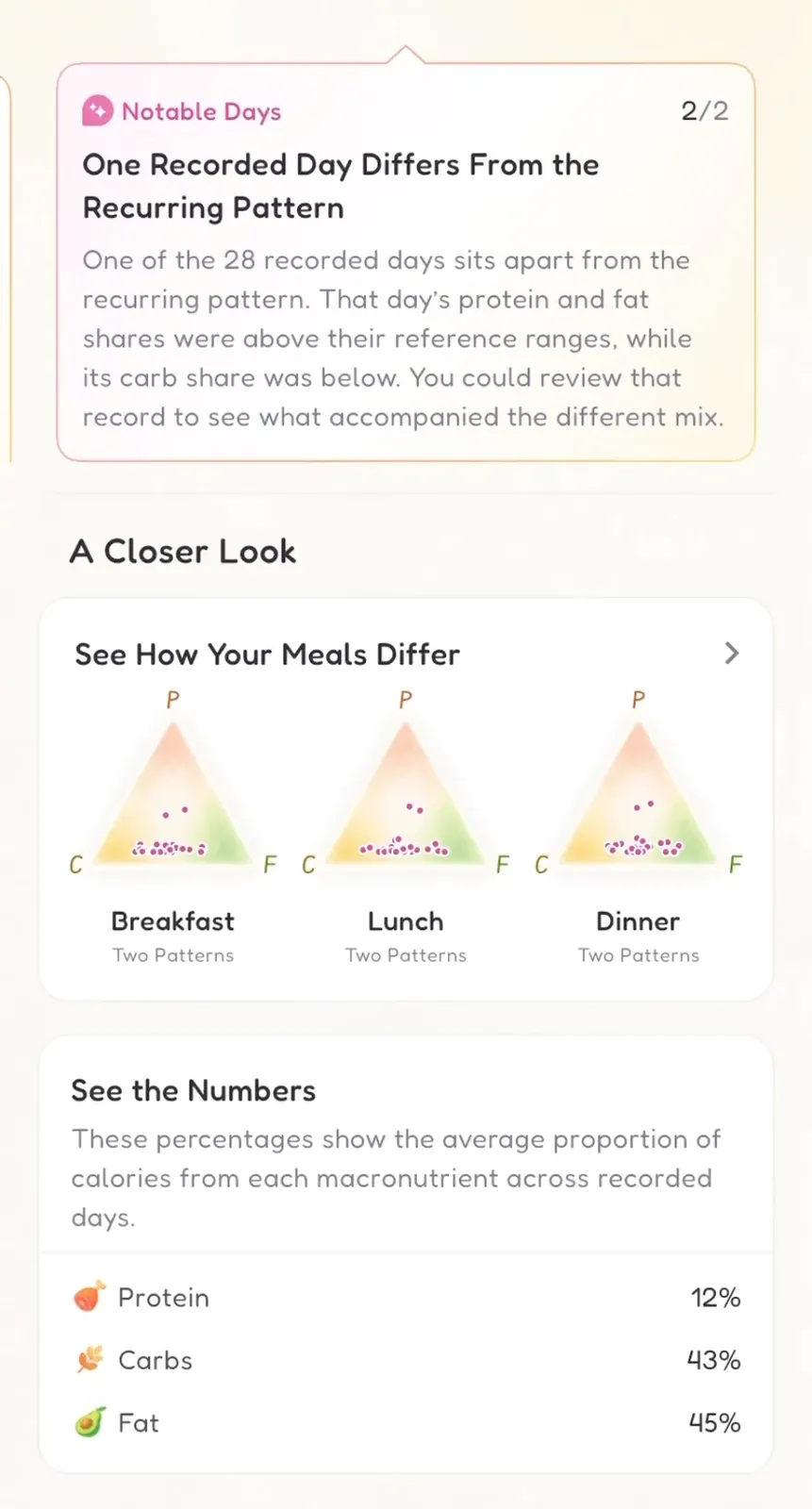
For instance, if breakfast looks quite different from lunch and dinner, you can revisit those entries to see which foods account for it. Check the portions and protein grams there against your agreed target; the pattern chart alone cannot tell you whether you reached it.
The analysis describes the records you have entered. It does not measure muscle mass, diagnose a nutrient deficiency, or establish that you have eaten enough protein. A point outside a reference area is a prompt to look more closely, not a medical diagnosis.
If you would like to keep your meals together and get a clearer view of your eating patterns, download Shelog. You can use the records to prepare for a nutrition review—with specific meals to discuss, rather than trying to remember everything you ate last week.
What If You Are Not Hungry Enough to Reach Your Target?
When you feel full after a few bites, another list of high-protein foods may not be much help.
Cleveland Clinic's GLP-1 diet guidance notes that appetite can decrease while the need for varied nutrients remains. Its food examples include fish, chicken, tofu, beans, produce, and whole grains; it also recommends individualized support from a registered dietitian.
Alongside your meals, note what still appeals to you, when eating feels easier, and whether a particular texture puts you off. Those details can help your dietitian suggest foods, portions, or a schedule that feels more manageable.
You do not have to force your way through a meal you cannot tolerate or turn every meal into a protein challenge.
If you are repeatedly unable to eat enough, contact your care team rather than treating stronger appetite suppression as an invitation to keep cutting back. Seek prompt medical advice for persistent vomiting, difficulty keeping fluids down, or concerning new symptoms. Do not change your medication dose yourself to solve the problem.
Protein Is Only One Part of Looking After Muscle
The joint advisory emphasizes that more protein alone is unlikely to preserve muscle without structured resistance training. Read its nutrition and exercise discussion.
That does not mean you need to jump into a demanding workout plan. Ask what kind of strength activity is appropriate for your health and experience, especially if you feel weak or have physical limitations.
A food diary can help organize the nutrition conversation. It cannot tell you how much muscle you have kept or lost, and a falling scale number cannot answer that question on its own. If strength or physical function is changing, discuss it rather than trying to solve everything by increasing a protein number.
Common Questions About Protein on GLP-1s
Is 100 grams of protein the right amount for every woman?
No. A round number may be easy to remember, but it does not account for an individual's health, body size, intake, or treatment plan. Ask for a target that fits you rather than assuming that a number within a published range must be your personal goal.
What if I miss my target on one day?
Keep the context with the record: what you ate, what was left, and whether symptoms or missing entries affected it. Discuss a recurring difficulty with your care team instead of treating each day as pass or fail.
Start with a target that fits your health, then use a few days of food records to see how it works in everyday life. If eating enough remains difficult, those records give you and your clinician something concrete to work through together.
Sources
- Mozaffarian et al. (2025): Nutritional priorities to support GLP-1 therapy for obesity—joint advisory
- NIDDK: Healthy Eating for Adults with Chronic Kidney Disease
- FDA: How to Understand and Use the Nutrition Facts Label
- Cleveland Clinic: GLP-1 Diet Guidance
This article provides general education for adults, not an individualized protein prescription or advice to start, stop, or change medication.
This article is for general education and is not a substitute for personal medical or nutrition advice.
More From Shelog
Keep Reading
Take Shelog with you
Take Shelog with you
Shelog turns the ideas in this article into a simple daily diary—food, mood, movement, and weight in one calm place.