

How to Estimate Portion Sizes Without a Scale
Estimate food portions without a scale using package labels, measuring cups, and spoons. See three examples with calories, protein, carbs, and fat.
Shelog Editorial
Reviewed for clarity and care

Lunch is ready, and the rice is already in your favorite bowl. Then your food log asks how many grams you had. You know roughly how full the bowl was. What do you put down?
To estimate portion sizes without a scale, count foods that come in pieces, use a measuring cup for loose foods like rice, and use a level measuring spoon for spreads. Look up the food in the same unit you used. If lunch is already on the table and you’re going by eye, use the fill level of a familiar bowl as a rough guide.
The examples below show how those everyday measures translate into calories, protein, carbs, and fat. Plug in the amount you ate.
Count Crackers and Check the Serving Size
If you put 18 crackers on your plate and eat them all, you already have a number to work with. The US Cheez-It Original label lists 150 calories, 3 g protein, 18 g carbs, and 8 g fat per 27 crackers.
Eighteen crackers are two-thirds of a labeled serving. Multiply each number by 18 ÷ 27 and you get 100 calories, 2 g protein, 12 g carbs, and about 5.3 g fat. This works best with pieces of similar size. If you’re picking through crumbs at the bottom of the box, treat the count as approximate.
For a snack bag, check the servings per container too. If the bag has two labeled servings and you finish it, double the per-serving numbers. Some labels do that math in a whole-package column. The serving size tells you what the label’s figures refer to, while your portion is how much you ate. FDA serving size guide
Use a Measuring Cup for Cooked Rice
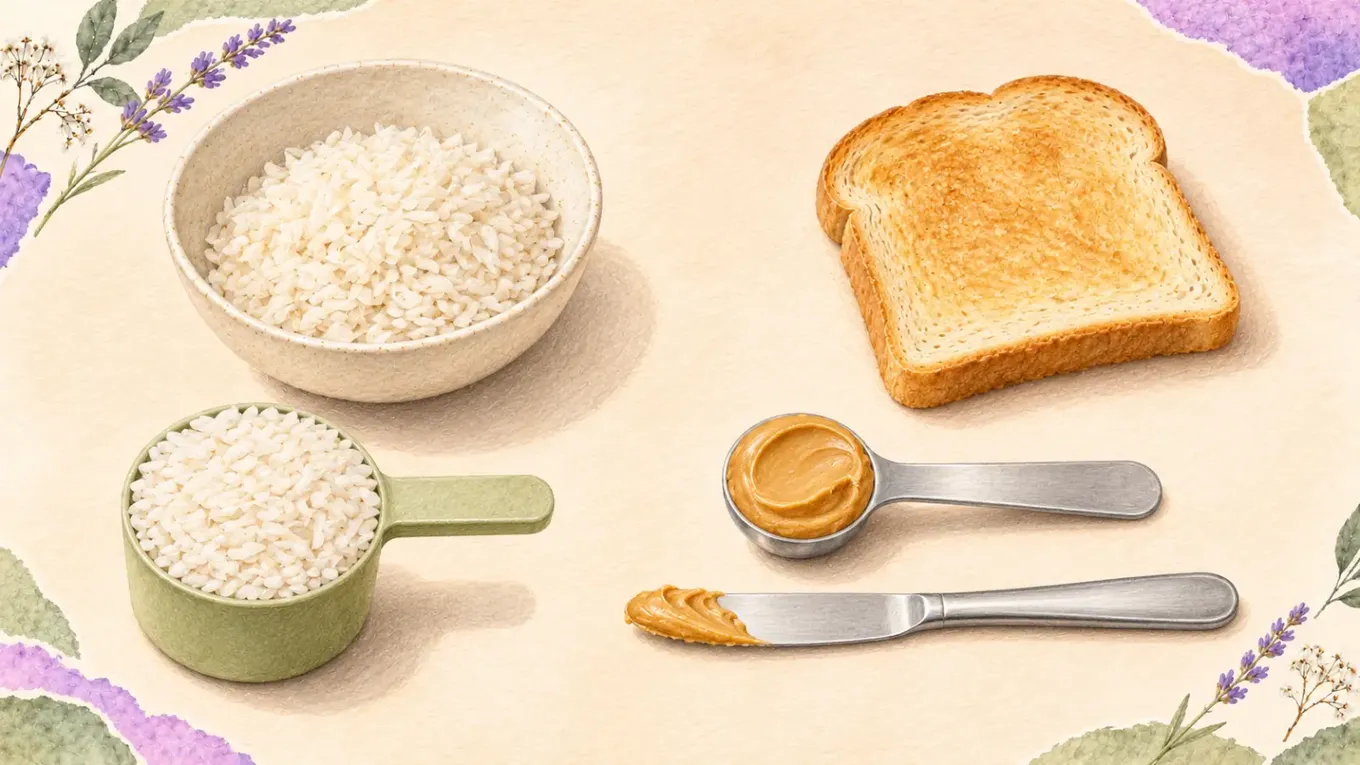
For rice you’re about to serve, spoon it loosely into a dry measuring cup and sweep the top level. Pressing the grains down lets you fit more rice into the same cup. If you’ve already served lunch, you can measure a similar scoop to get a sense of how much went into your bowl.
For plain cooked long-grain white rice, the USDA FoodData Central reference puts one cup at 158 g. Half a cup corresponds to about 79 g in that entry, or 103 calories, 2.1 g protein, 22.3 g carbs, and 0.2 g fat. If your food log offers the matching cooked rice entry in cups, enter half a cup directly. If the entry only takes grams, 79 g is a reference estimate for that rice.
Search for “cooked white rice” for this example. Dry rice and fried rice are different entries. If you added butter to your own bowl, include it separately when you use the plain rice entry. For a mixed dish you cooked yourself, see our guide to counting calories in homemade food.
Use a Level Measuring Spoon for Peanut Butter
A swirl of peanut butter is easy to see on a spoon and harder to judge once it’s spread across toast. Fill a measuring teaspoon and run the flat side of a butter knife across the rim. If you’re using the numbers on your jar, check whether they’re listed per teaspoon or tablespoon.
The USDA reference for smooth unsalted peanut butter puts 2 tablespoons at 32 g. Two tablespoons hold six teaspoons. If you spread two level teaspoons, that’s a third of the reference amount, or roughly 11 g. Keeping the full value until the end of the calculation gives 64 calories, 2.4 g protein, 2.4 g carbs, and 5.5 g fat for the peanut butter. Add the toast entry if you’re logging the whole snack.
| Food | Portion you ate | Calories | Protein | Total carbs | Fat |
|---|---|---|---|---|---|
| Cheez-It Original crackers | 18 crackers | 100 | 2.0 g | 12.0 g | 5.3 g |
| Plain cooked long-grain white rice | ½ cup | 103 | 2.1 g | 22.3 g | 0.2 g |
| Smooth unsalted peanut butter | 2 level tsp | 64 | 2.4 g | 2.4 g | 5.5 g |
Calories are rounded to the nearest whole number and macros to one decimal place. The cracker example comes from the US product label. The rice and peanut butter come from USDA reference foods. Your package or preparation can give different values.
Estimate by Eye When You Have No Measuring Tools
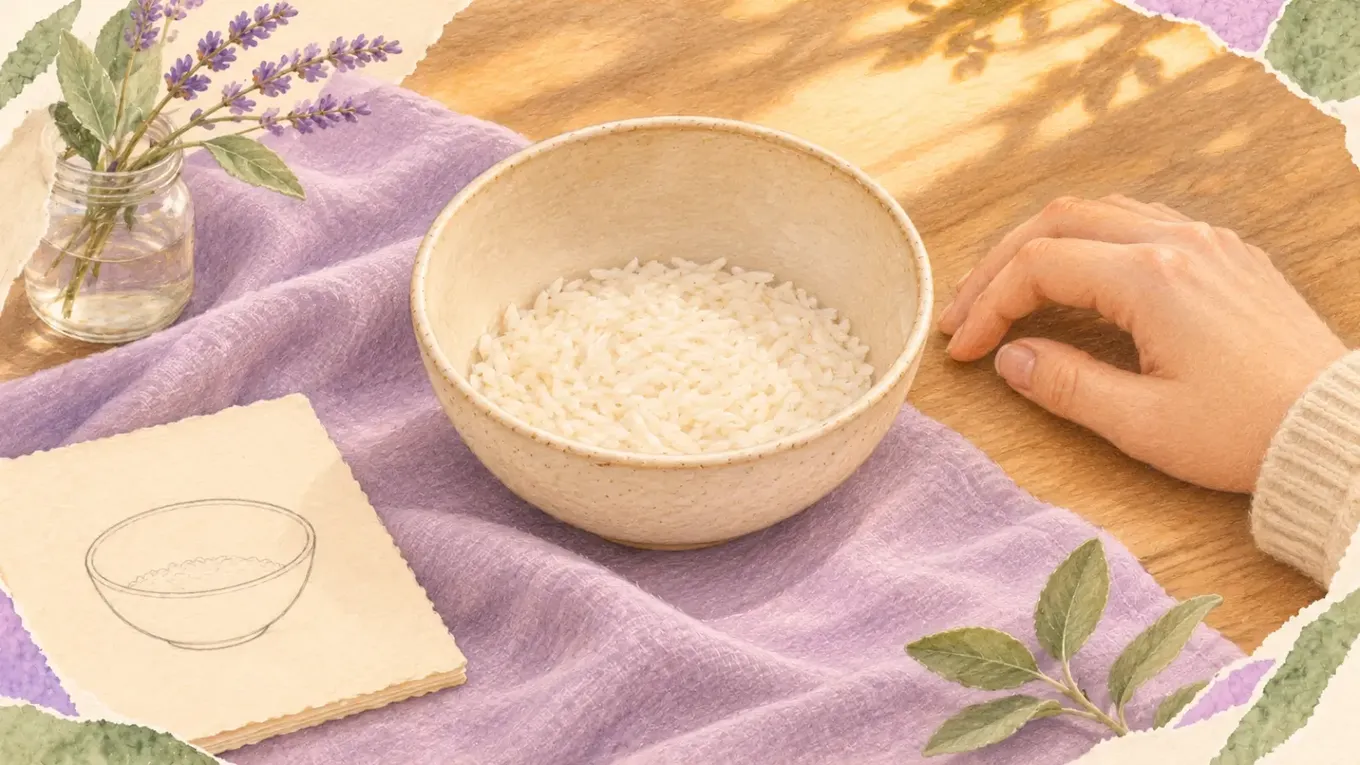
Try tipping a measured half cup of cooked rice into the bowl you reach for most. You might find it barely covers the bottom. Once you know what it looks like in that bowl, you have a reference for the next time you serve rice. A similar fill level works as a volume cue. Use a separate food entry if the bowl is filled with something else.
Away from home, a palm can help you describe a piece of chicken. Include thickness if you can. A thin cutlet and a thick piece can cover the same part of your palm. Research comparing hand and household estimates found that results depend on the shape of the food and on how the estimate is made. Use your hand to describe size without assigning it a fixed gram value.
A photo can remind you whether the rice was a thin layer or a mound. The oil stirred into it may be harder to spot. Shelog’s Food Calorie Checker can estimate calories and macros from a meal photo. Check the result against anything you know about the amount or the ingredients. For meals with published menu nutrition or shared plates, see our guide to tracking calories when eating out.
Record the Amount You Know in Shelog
If you’re going back to that lunch bowl, try describing it in Shelog as “about half a cup of plain cooked white rice.” For the crackers, you can search by brand and compare the suggested serving with the one on your box. The amount belongs in the description even when it’s an estimate.
Download Shelog on the App Store to log meals by search, photo, or description and see calories, protein, carbs, and fat in your food diary.
Common Questions About Estimating Portions
What does a 3 oz portion look like without a scale?
It depends on the food. Three ounces is a weight of about 85 g, so start with a matching reference. If a package contains 6 oz of one fairly uniform food, half the contents is about 3 oz. For an unlabeled piece of fish, a visual comparison gives you a rough size, and its thickness matters too.
Can I use a regular spoon to measure a teaspoon?
Use a spoon marked 1 tsp when you need a standard measure. An everyday spoon can help you serve a repeatable amount once you’ve compared it with a measuring spoon. Its bowl size and how much you heap onto it affect the result.
Can I track calories and macros without weighing food?
Yes. Start with a label or database entry for the food and scale all four numbers to the portion you ate. For example, half a listed serving gives you half its calories, protein, carbs, and fat. If a clinician has asked you to measure food a specific way, follow their guidance for that purpose.
Sources
- FDA guidance on serving size and servings per container.
- Cheez-It Original US product label, 12.4 oz package.
- USDA FoodData Central SR Legacy data, record 168878 for cooked enriched long-grain white rice and record 172470 for smooth unsalted peanut butter.
- Gibson et al., study of hand and household measures for portion estimation, Journal of Nutritional Science, 2016.
This article is for general education and is not a substitute for personal medical or nutrition advice.
Take Shelog with you
Take Shelog with you
Shelog turns the ideas in this article into a simple daily diary—food, mood, movement, and weight in one calm place.