

How to Count Calories in Homemade Food: A Worked Example
Count calories in homemade food with a worked recipe, calories and macros per serving, and clear steps for weighing ingredients and cooked portions.
Shelog Editorial
Reviewed for clarity and care
Imagine dinner bubbling away while you scroll through several versions of “homemade pasta” in your food diary. One includes cream. Another seems to be mostly cheese. Yours has chickpeas, tomatoes and spinach, and tonight’s bowl might be bigger than tomorrow’s lunch.
To count calories in homemade food, add up the calories in the ingredients you actually use, then calculate the share you eat. For four equal portions, divide the batch total by four. For different-sized bowls, weigh the finished food and multiply the batch total by your portion’s share of that weight. Use the same calculation for protein, carbohydrates and fat.
The pasta example below comes to about 1,406 calories for the whole batch, or 351 calories for one quarter. You’ll also see the protein, carbs and fat in each portion, with all the ingredient amounts included so you can check the math.
Weigh Your Ingredients and Check the Nutrition Entries
Start with a kitchen scale, your ingredient labels and a place to jot down quantities. Grams make it easy to scale values listed per 100 g or per labeled serving.
For a packaged ingredient, read the serving weight alongside the calories. For example, if a sauce lists 80 calories per 125 g and you use 250 g, it contributes 160 calories. A jar can contain several labeled servings. The FDA’s serving-size guide explains how those portions appear on the label.
For basic foods, look for a matching entry in USDA FoodData Central. Read the preparation description as carefully as the food name. Dry pasta, cooked pasta, raw spinach and cooked spinach have different amounts of water in a given weight.
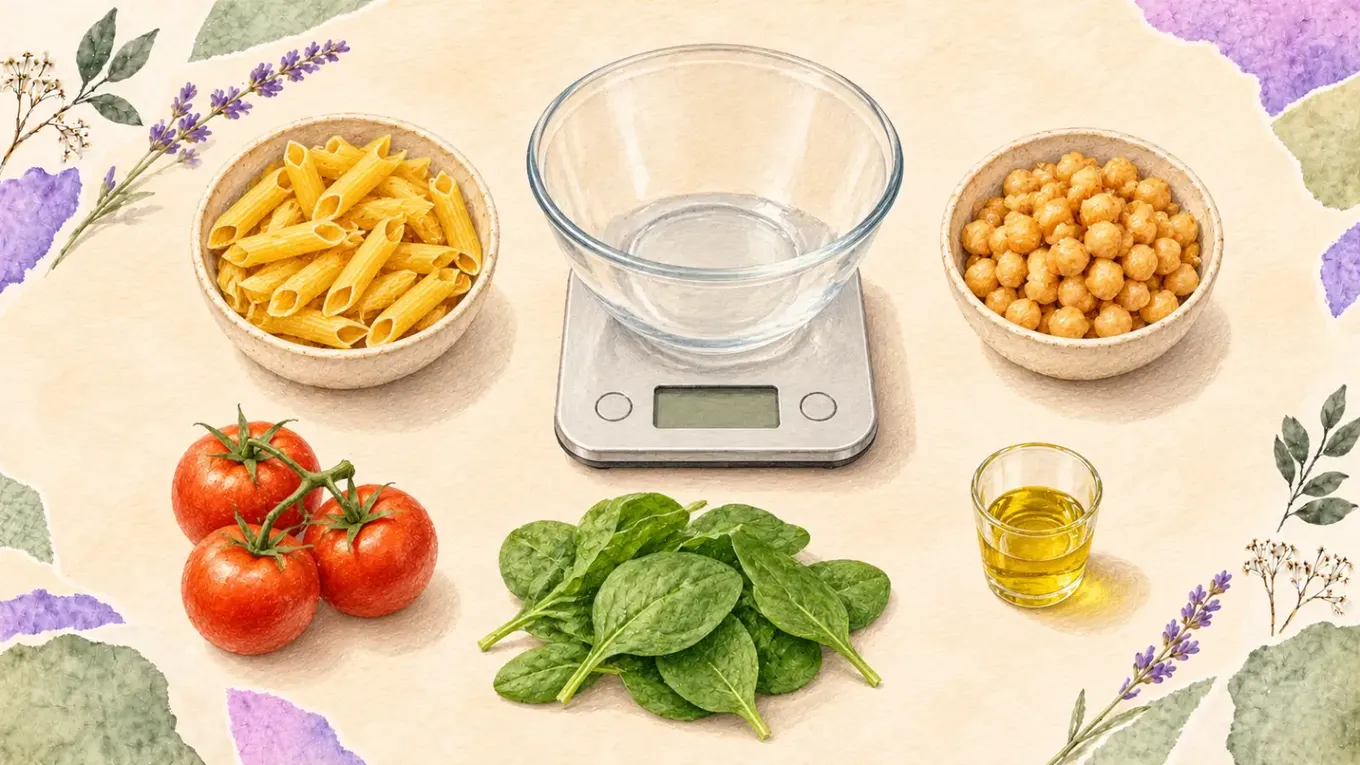
Place a bowl on the scale, press tare to zero it, then add the ingredient. Write down its weight before moving it to the pot. Repeat for the remaining ingredients. Check your scale’s capacity and keep hot cookware off a scale that is not designed for it.
Calculate the Whole Recipe’s Calories and Macros
Imagine making pasta with cooked chickpeas, tomatoes, spinach and olive oil. These quantities give us a simple worked example. Adapt your own meal to your appetite and dietary needs, then calculate from the amounts you use.
Boil and drain the pasta, soften the tomatoes in the measured oil, wilt the spinach, then toss everything with the cooked chickpeas. The chickpeas are weighed after cooking and draining; the pasta is weighed dry. If you use canned chickpeas, choose the drained canned entry or follow the can’s label for the amount you use.
| Ingredient and weighing state | Amount used | Calories | Protein | Total carbs | Fat |
|---|---|---|---|---|---|
| Enriched pasta, dry | 200 g | 742 | 26.1 g | 149.3 g | 3.0 g |
| Chickpeas, boiled without salt, drained | 250 g | 410 | 22.2 g | 68.6 g | 6.5 g |
| Tomatoes, raw | 300 g | 54 | 2.6 g | 11.7 g | 0.6 g |
| Spinach, raw | 100 g | 23 | 2.9 g | 3.6 g | 0.4 g |
| Olive oil | 20 g | 177 | 0 g | 0 g | 20.0 g |
| Whole batch | All five ingredients | 1,406 | 53.7 g | 233.2 g | 30.5 g |
These estimates use foods from USDA’s Standard Reference archive. Totals are calculated before rounding, so displayed rows may differ slightly from their displayed sum. Your brand, ingredient varieties and cooking losses can change the result. This example counts all 20 g of oil as part of the food served.
Ingredient calories = grams used ÷ reference grams × reference calories.
For the dry pasta, the reference is 371 calories per 100 g. The calculation is 200 ÷ 100 × 371 = 742 calories. Chickpeas use their cooked reference of 164 calories per 100 g, so 250 ÷ 100 × 164 = 410 calories. Repeat with the protein, carbohydrate and fat values.
The oil contributes about 177 calories to this batch. A second 20 g pour would add another 177 calories, or about 44 calories to each of four equal portions. Measuring the oil gives you a more useful starting figure than trying to judge it from the finished dish.
Calculate Calories per Serving Using the Cooked Weight
If you divide the food evenly into four containers, each gets one quarter of the batch. That works out to about 351 calories, 13.4 g protein, 58.3 g carbs and 7.6 g fat per container.
If people take different amounts, use the weight of the cooked food. Suppose this particular batch weighs 1,200 g after cooking, once the container is subtracted. We’re using that assumed weight to demonstrate the math. Measure your own batch because cooking time and added water can change its yield.
Portion calories = batch calories × portion weight ÷ finished food weight.
A 300 g bowl is 300 ÷ 1,200 = one quarter of the batch. A 400 g bowl is one third. The calculation also gives you the share of each macronutrient.
| Amount of this finished batch | Share of batch | Calories | Protein | Total carbs | Fat |
|---|---|---|---|---|---|
| 240 g | One fifth | 281 | 10.7 g | 46.6 g | 6.1 g |
| 300 g | One quarter | 351 | 13.4 g | 58.3 g | 7.6 g |
| 400 g | One third | 469 | 17.9 g | 77.7 g | 10.2 g |
For tomorrow’s lunch, write down the fraction of the batch you packed before putting it in the fridge. That fraction still applies after reheating, even if some water evaporates. If you add cheese, pesto or a separate side at lunchtime, include that addition in the lunch entry.
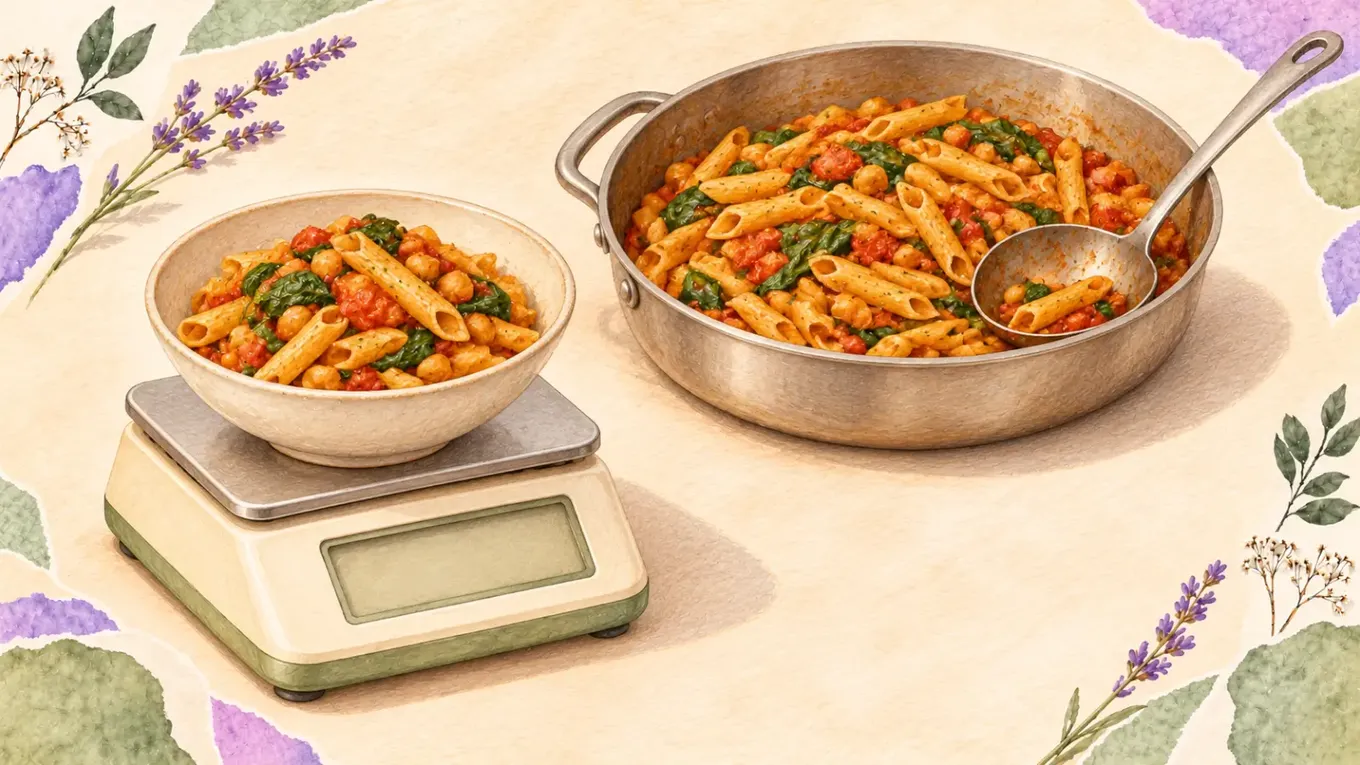
This method assumes the food is reasonably evenly mixed. Give the pasta a good toss before dividing it. For a tray with separate chicken pieces, potatoes and vegetables, calculate or log the components on your plate individually when their proportions differ substantially between servings.
Should You Weigh Homemade Food Raw or Cooked?
Use a nutrition entry that matches the state you weighed. In this example, that means a dry entry for the 200 g pasta and a cooked entry for the 250 g chickpeas.
Pasta absorbs water during boiling. A bowl of cooked pasta contains more water per gram than the dry pasta that went into the pot. For the batch method, record the dry ingredient once, then use the finished weight to divide the dish. Adding a second entry for the cooked pasta would count that ingredient twice.
Cooking can also involve moisture loss and fat gain or loss. USDA’s cooking-yield research describes why raw and cooked weights need to be treated differently. If you discard substantial fat, liquid or other edible material, the original ingredient sum will include some food that was left behind. Choose a suitable cooked entry or adjust the calculation when you can account for that discarded material.
There is no single raw-to-cooked multiplier that works for every pot of pasta, cut of meat or cooking method. Measuring the batch you made avoids relying on one.
When You Didn’t Weigh the Ingredients
If someone else cooked dinner, ask about the main ingredients and any oil, cream, cheese or sauce. A reasonably similar prepared-food entry can be useful when you have little information. If the foods are separate on the plate, estimate the components you can identify.
For a quick starting estimate of one food, the Shelog Food Calorie Converter accepts a food description and weight and returns estimated calories and macros. Include the preparation state, such as “cooked pasta.” For a mixed dish with known ingredients, the worked calculation above gives you a more transparent record of what went into it.
For meals away from home, our guide to tracking calories when eating out covers menu information and choosing a comparable entry.
Keep Your Homemade Meals in Shelog
You’ve done the useful part by figuring out what went into dinner and how much reached your bowl. Shelog gives you a place to keep that meal alongside your calories, protein, carbs and fat. You can search for foods, take a photo or describe what you ate.
For this dinner, “chickpea pasta with tomatoes, spinach and olive oil, about a quarter of the batch” captures more than “pasta.” Use your ingredient notes to check the foods and quantities suggested in your entry. A photo helps you remember the meal; the weighed ingredients and your calculation provide the numbers to compare with it.
Download Shelog on the App Store and bring your homemade meals into your food diary.
Questions About Counting Calories in Homemade Food
How do I calculate calories per 100 g of a homemade meal?
Divide total batch calories by finished food weight in grams, then multiply by 100. The example is 1,405.8 ÷ 1,200 × 100, or about 117 calories per 100 g. Weigh the food after cooking and subtract the container.
Can I divide the calories by the number of people eating?
You can if everyone eats an equal share. If one person takes a small bowl and another has seconds, weigh portions or use their estimated fractions of the batch. Include leftovers in your division, too.
Why don’t the calories exactly match protein × 4 + carbs × 4 + fat × 9?
Food labels and databases can use different energy factors and rounded nutrient values. Adding displayed macro values back together may produce a different total. Keep the listed energy value from each food record for the calculation. The FDA’s food-labeling guidance explains energy calculations and rounding.
Do I need to calculate every meal this way?
Choose the level of detail that helps you. Measuring a familiar meal once can give you a useful reference. Other nights, a description or a reasonable estimate may fit better. If tracking is becoming distressing or pushing you to skip food, seek support from a qualified healthcare professional.
Sources
- USDA FoodData Central. Reference entries for dry enriched pasta, boiled chickpeas without salt, raw tomatoes, raw spinach and olive oil.
- USDA Standard Reference Release 28, revised May 2016. Archived reference data, food records 20120, 16057, 11529, 11457 and 04053, used for this worked calculation.
- FDA. Serving size on the Nutrition Facts label.
- USDA Agricultural Research Service. The USDA Table of Cooking Yields for Meat and Poultry.
- FDA. Developing and using databases for nutrition labeling.
This article is for general education and is not a substitute for personal medical or nutrition advice.
Take Shelog with you
Take Shelog with you
Shelog turns the ideas in this article into a simple daily diary—food, mood, movement, and weight in one calm place.