

Estrogen and Weight Gain: What It Can—and Cannot Explain
Can low or high estrogen cause weight gain? Learn what estrogen may change, what the scale cannot diagnose, and what to check before blaming hormones.
Shelog Editorial
Reviewed for clarity and care

Your weight changed. Maybe your waist feels different, your usual routine no longer seems to work in quite the same way, or the change arrived alongside irregular periods, hot flashes, or restless nights. It makes sense to wonder whether estrogen is involved.
Here is the honest short answer: estrogen can influence body composition and where fat is stored, especially during the menopause transition. But weight gain alone cannot tell you whether estrogen is low, high, or “imbalanced.”
A scale measures everything together. It cannot separate body fat from muscle, water, digestion, or normal day-to-day variation—and it certainly cannot measure a hormone.
Does an Estrogen Imbalance Cause Weight Gain?
Sometimes estrogen changes may be one part of the picture. They are rarely the whole picture.
The phrase “estrogen imbalance weight gain” sounds like one diagnosis with one solution. In real life, it can refer to several different questions:
- Did your total body weight change?
- Did your amount of body fat change?
- Did fat begin to collect in a different place, such as around your waist?
- Is a short-term fluid change making the scale or your clothes feel different?
- Are symptoms, sleep, activity, medicines, age, or another health condition also involved?
Those questions do not have the same answer. Keeping them separate is the first step toward understanding what is actually happening.
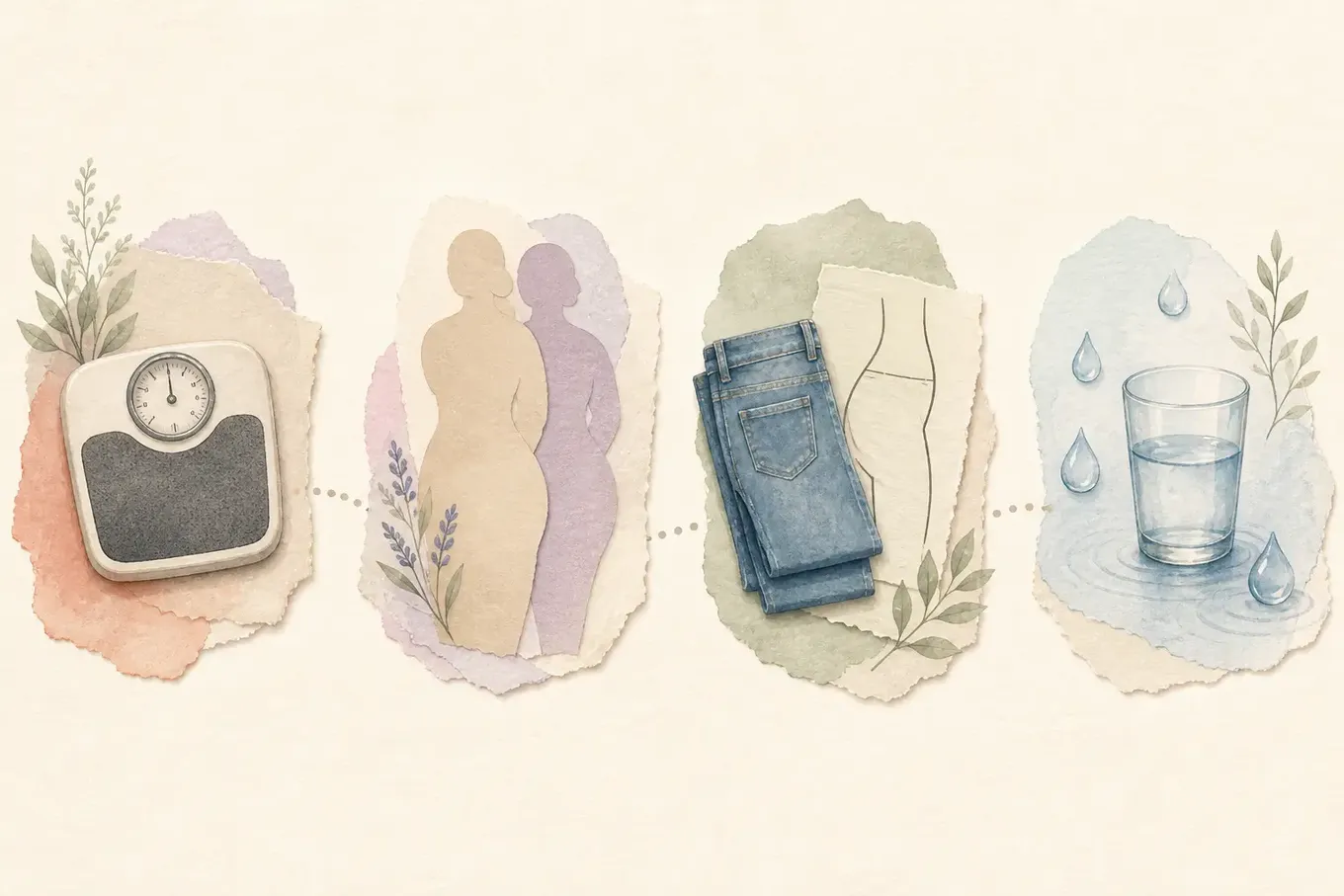
The National Institute on Aging notes that the body begins to use energy differently during the menopausal transition: fat distribution may change, weight may become easier to gain, and women may lose muscle while gaining fat. That is more nuanced than “estrogen made me gain weight.”
Low Estrogen: The Clearest Evidence Comes From Menopause
When people ask whether low estrogen causes weight gain, they are often asking about perimenopause or menopause.
During this transition, ovarian production of estrogen and progesterone declines. Many women notice changes in their waist, body shape, sleep, energy, or weight around the same years. Research does support a connection—but not a simple one-hormone explanation.
Reviews of the evidence distinguish scale weight from body composition. A review indexed by PubMed concluded that weight gain itself could not be attributed only to the menopause transition, while hormonal changes were associated with more total and abdominal fat. A newer critical review similarly found more fat around the waist and less lean mass, but concluded that endocrine changes alone were not enough to explain everything observed.
In plain language, two things can be true at once:
- Aging, activity, sleep, food, stress, medicines, and gradual muscle loss may affect total weight.
- Declining estrogen and the wider hormonal shift of menopause may affect body composition and encourage a more abdominal pattern of fat storage.
That is why someone may notice a changing waist even when her total weight changes only a little. It is also why “just eat less” and “it is all your hormones” are both incomplete answers.
Does High Estrogen Cause Weight Gain?
A higher weight does not prove that estrogen is high.
Estrogen is not one fixed number. It is a group of hormones, and levels vary with age, menstrual and reproductive stage, pregnancy, medicines, and health conditions. MedlinePlus explains that different forms of estrogen may be tested for specific clinical reasons—not simply because a person gained weight.
The relationship can also run in the other direction. Ovaries are not the only source of estrogen: body fat contributes to production of estrone, a form of estrogen that remains important after menopause. The US Office on Women's Health notes that fat cells produce estrogen and that more body fat can affect hormone levels and menstrual patterns.
So a claim that “high estrogen caused the weight” may reverse cause and effect, ignore the reason estrogen is high, or mistake two changes that happened together for proof that one caused the other.
This is also why labels such as “estrogen dominance” should be treated cautiously. They may sound precise while combining different symptoms, cycle stages, conditions, and lab results into one story. An online checklist cannot tell you which—if any—applies to you.
Weight is not an estrogen test. Body shape is not an estrogen test either.
Can Estrogen or Hormone Therapy Help You Lose Weight?
Hormone therapy is not a weight-loss treatment.
The American College of Obstetricians and Gynecologists says that estrogen used in menopausal hormone therapy may change where fat is stored, but hormone therapy by itself does not lead to weight loss. It may indirectly make weight management feel more manageable for some women if it relieves night sweats and improves disrupted sleep.
The Menopause Society also states that hormone therapy is not associated with weight gain. Its purpose is to treat appropriate menopause symptoms and conditions after an individualized discussion of benefits and risks—not to make the scale move.
That distinction matters:
- Not being associated with weight gain is not the same as causing weight loss.
- A possible change in fat distribution is not the same as a guaranteed change in total weight.
- Feeling better after symptom treatment may support daily routines, but it does not turn estrogen into a slimming medication.
Do not start, stop, or change prescribed hormones because of an article, social post, supplement advertisement, or scale reading. The right treatment depends on why it is being considered and on your individual health history.
How Do You Know Whether Hormones Deserve a Closer Look?
Start with context, not a verdict.
Ask what changed and when:
- Was this one unusual weigh-in or a repeated change across comparable weeks?
- Did your waist or clothing fit change even though weight stayed similar?
- Are you in the menopause transition, when hormone patterns commonly change?
- Have your periods changed in timing, flow, or regularity?
- Did sleep, stress, activity, food, alcohol, travel, or digestion change too?
- Did you start or change a medicine, hormonal contraceptive, supplement, or hormone treatment?
- Are there persistent symptoms that concern you?
These observations cannot diagnose an estrogen problem. They can help you describe the pattern more clearly to a qualified clinician.
If you are wondering about perimenopause, a hormone test is not always the first or most useful answer. ACOG says most women do not need hormone testing for it; clinicians often use age, symptoms, and changes in periods, with testing considered in particular circumstances such as possible early menopause.
A Calm Check Before You Change Your Plan
When your body feels unfamiliar, the urge to fix everything at once can be strong. Try a shorter review first.

1. Make the weight comparison fair
Compare measurements taken under roughly similar conditions. One morning cannot tell you whether body fat, estrogen, or anything else changed. Water, digestion, menstrual timing, exercise, and meal timing can make a real scale change that is not the same as fat gain.
2. Look beyond the scale
Notice clothing fit, waist changes, strength, energy, sleep, and how sustainable your routine feels. None is a hormone test, but together they give a more useful picture than weight alone.
If your weight shifted after starting a new training plan, use the timing check in Working Out but Gaining Weight? before assuming the workout—or estrogen—is to blame.
3. Reconstruct what actually happened
Look back at food and drinks, mood, workouts, water, sleep, travel, and medicines without turning the review into a trial against yourself. A kinder food diary can help you notice changes without labelling meals as “good” or “bad.”
4. Choose one useful next step
That might mean keeping your routine steady while gathering clearer measurements, protecting sleep, adding strength work that suits you, discussing a medicine with its prescriber, or booking a health appointment.
Avoid changing your diet, workouts, supplements, weighing schedule, and medication at the same time. When everything changes, it becomes harder to learn anything from the result.
How Shelog Can Help You Stay With the Facts
Shelog brings food, mood, workouts, water, and weight into one diary. When something changes, you can look back at the surrounding days instead of asking one number to explain your body.
You might notice that the higher weights were isolated, that meals, mood, workouts, or water changed during a demanding week, or that the pattern continued despite a stable routine. That context can help you choose a calmer next step or have a more concrete conversation with a health professional.
Shelog does not measure estrogen, diagnose a hormone imbalance, determine whether weight is water or fat, or recommend hormone treatment. Weight Trend uses recent weight records to estimate short-term direction and show uncertainty; it does not use hormone levels, menstrual-cycle data, food, workouts, or symptoms to explain the cause.
When to Talk With a Health Professional
Consider medical advice when weight or body changes are rapid, unexplained, persistent, or accompanied by symptoms that concern you. It is especially useful to speak with a clinician if you have:
- new or significant changes in your periods
- possible pregnancy
- hot flashes, night sweats, or other symptoms affecting daily life
- symptoms of menopause before age 45, especially before 40
- rapid weight gain, swelling, or shortness of breath
- a new medicine or hormone treatment followed by a concerning change
- marked fatigue, dizziness, hair loss, feeling unusually cold, or other persistent symptoms
- eating, exercise, or weighing habits that are becoming distressing or compulsive
MedlinePlus notes that rapid unintentional weight gain can sometimes be a sign of fluid retention. Seek prompt medical advice if a rapid change comes with swelling or shortness of breath, and do not wait for a weight trend or hormone test if you feel seriously unwell.
The Takeaway
Estrogen may be part of a weight or body-shape change, particularly around menopause. But the strongest evidence is about a wider transition: aging, changing body composition, declining lean mass, sleep and activity changes, and a tendency for fat to move toward the abdomen.
Low estrogen, high estrogen, fat gain, and fluid change are not interchangeable explanations. Start with the pattern you can actually observe, keep treatment decisions with a qualified clinician, and give your body a more thoughtful review than one number—or one hormone—can provide.
Sources
- National Institute on Aging: What Is Menopause?
- American College of Obstetricians and Gynecologists: Can Hormone Therapy During Menopause Help Me Lose Weight?
- American College of Obstetricians and Gynecologists: Do I Need Hormone Testing During Perimenopause?
- MedlinePlus: Estrogen Levels Test
- MedlinePlus: Weight Gain—Unintentional
- US Office on Women's Health: Your Menstrual Cycle and Your Health
- The Menopause Society: Hormone Therapy
- Climacteric: Understanding Weight Gain at Menopause
- Gynecological Endocrinology: Body Weight and Fat Mass Across the Menopausal Transition
- Mayo Clinic Proceedings: Weight Gain in Women at Midlife
This article is for general education and is not a substitute for personal medical or nutrition advice.
More From Shelog
Keep Reading
Take Shelog with you
Take Shelog with you
Shelog turns the ideas in this article into a simple daily diary—food, mood, movement, and weight in one calm place.