

Working Out but Gaining Weight? What Women Should Check First
Working out but gaining weight? Before you change your plan, use this calm five-question check to understand what the scale may—and may not—be showing.
Shelog Editorial
Reviewed for clarity and care

You started working out because you wanted to feel stronger, healthier, or more at home in your body. Then the scale went up. If you are exercising but gaining weight, it can feel as if your effort is somehow working against you.
It is frustrating—especially when you have been making a real effort. But a higher number does not automatically mean your plan is failing, and it does not automatically mean you gained fat. It is simply one piece of information that needs context.
Before you eat less, train harder, or throw away the routine, ask one calmer question:
Did the change happen after one workout, during the first few weeks, or across several comparable weeks?
That timing can tell you much more than one isolated number.
Why Am I Gaining Weight While Working Out?
A scale cannot separate fat, muscle, water, stored carbohydrate, or food still being digested. It only shows their combined weight at that moment.
Starting or increasing exercise may also change soreness, hydration, hunger, meal timing, recovery, and how active you feel during the rest of the day. Menstrual-cycle-related fluid changes may be happening at the same time.
This is why exercise and scale weight rarely move together in a neat straight line. The National Institute of Diabetes and Digestive and Kidney Diseases explains that physical activity may have only a modest effect on weight loss while still supporting health and long-term weight maintenance.
In other words: the workout can be helping even when tomorrow morning's number is not lower.
First, Check When the Change Happened

It appeared after one new or difficult workout
If the number changed overnight, pause before giving it a meaning. A salty meal, later dinner, more water, digestion, different clothing, menstrual timing, or temporary fluid around sore muscles can all affect the result. Cleveland Clinic includes food, hydration, hormones, and physical activity among the common reasons weight moves from day to day.
That next-day increase is too soon to call new muscle. It is also not enough evidence to call fat gain. Keep the next few days ordinary and look again under similar conditions.
It appeared during the first few weeks
A new routine asks your body to adapt. Your muscles use stored carbohydrate for activity, and those stores are connected with body water. Harder training, different meals, and a new hydration pattern can therefore make early weigh-ins noisier.
There is no reliable formula that can tell every woman exactly how much “workout water weight” she will hold or the day it will disappear. A scientific review of muscle glycogen and hydration found that the relationship is more variable than popular fixed-number rules suggest.
Give the pattern time to become visible. You do not have to earn that patience by exercising even harder.
It has continued across several comparable weeks
Now the question changes. Instead of focusing only on the workout, review the full routine around it: food and drinks, everyday movement, sleep, recovery, supplements, medicines, and menstrual timing if you already know it.
This is not an investigation into what you did “wrong.” It is a way to find out whether the higher numbers are temporary noise or a pattern that deserves one thoughtful adjustment.
If the trend is mostly flat, try the framework in Why Is My Weight Loss So Slow? A Two-Week Check. If a previously moving trend has clearly levelled off, use the one-change plateau review.
A Short-Term Increase Is Not the Same as Fat Gain
An overnight change can be completely real on the scale without representing the same change in body fat.
Short-term weight may move with:
- fluid involved in recovering from a hard or unfamiliar workout
- changes in stored carbohydrate and water
- a later meal or more fluid around training
- sodium, digestion, travel, or a different weigh-in time
- menstrual-cycle-related fluid changes
You do not need to guess which single factor caused today's number. Check whether the change remains when you compare several weigh-ins taken in roughly the same circumstances.
Our two-week weight-loss check can help you make those comparisons without letting every number set the mood for your day.
Could It Be Muscle?
Possibly—but “it must be muscle” is not a useful answer to every higher weigh-in.
Resistance training can gradually increase strength and lean mass while reducing fat mass. A recent systematic review of resistance training in adult women supports those longer-term benefits. It cannot tell you what caused one person's weight to rise this week.
Look for a fuller set of clues:
- Are you lifting more or moving with better control?
- Has your stamina improved?
- Do your clothes fit differently in a consistent place?
- Is the longer weight trend stable, rising, or simply bouncing around?
Smart scales that estimate body composition are not perfect referees. Their readings can also shift with hydration. Treat them as another trend to observe, not proof that a small change is definitely muscle or fat.
If the Higher Trend Continues, Look Beyond the Workout
The hour you exercise is only one part of the day. When the higher trend continues, gently review what has happened around that hour.
Food and drink
Some people feel hungrier when training changes. Others add a workout snack, sports drink, supplement, restaurant meal, or bigger portion without thinking much about it. None of those choices is automatically a problem, and you should not assume you “ate back” your workout.
Simply reconstruct what actually happened. A kinder food diary can help you notice a pattern without turning food into a moral scorecard.
The rest of your movement
A demanding session may leave you sitting more, walking less, or taking extra rest later. Sometimes that rest is exactly what your body needs. It still belongs in the wider picture of the week.
You do not need an exact calorie-burn calculation. Just notice whether work, commuting, caregiving, soreness, or fatigue made the rest of your day unusually quiet.
Recovery
If training is already difficult to recover from, the answer is not always another hard session or stricter eating. Sleep, rest days, pain, energy, mood, and performance can tell you whether the plan is sustainable.
Repeated injuries, falling performance, unusual exhaustion, compulsive exercise, or difficulty eating enough for your activity are reasons to pause the weight-loss troubleshooting and seek qualified support.
Add Cycle Context Without Blaming “Hormones”
Menstrual timing can affect fluid and scale weight, but it should not become a catch-all explanation.
If you already know your cycle timing, notice whether similar changes repeat at similar times. A study of weight across the menstrual cycle found a temporary average increase around menstruation that was associated with extracellular water, but individual experiences vary.
This comparison may be less useful if you use hormonal contraception, have irregular cycles, are postpartum, are in perimenopause, or do not menstruate. The goal is not to diagnose your hormones. It is simply to avoid comparing two days as if their contexts were identical.
Also pay attention to possible under-fuelling. The US Office on Women's Health explains that low energy availability can be connected with menstrual changes and poorer bone health. Missed or irregular periods, declining energy, or possible stress-fracture symptoms deserve professional care—not a stricter diet.
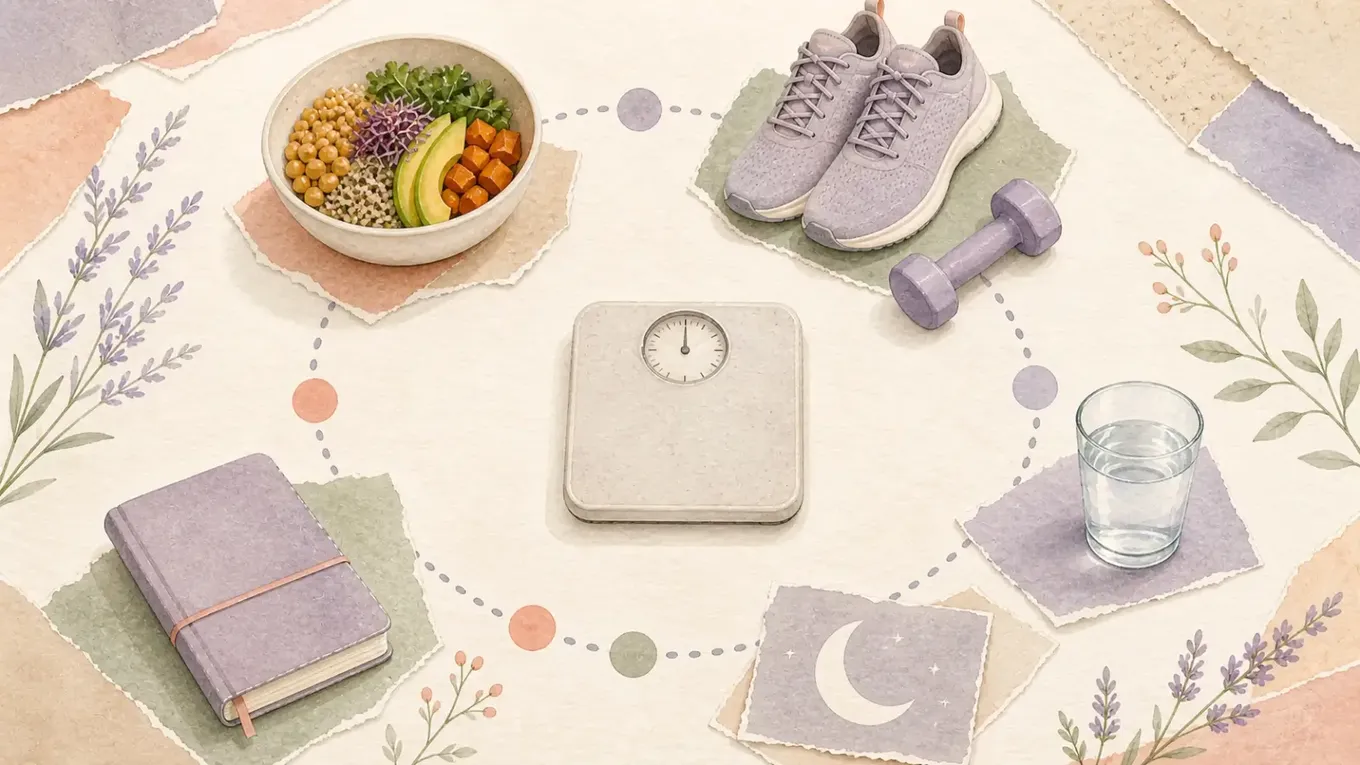
Five Questions to Ask Before You Change the Plan
You do not have to solve every possibility. Start here:
- Was it one weigh-in or a repeated trend? One unusual number usually calls for more comparable information, not an immediate reaction.
- Did your training recently change? Think about new exercises, heavier weights, longer sessions, and unusual soreness.
- What else changed at the same time? Look at meals, drinks, sleep, travel, digestion, everyday movement, supplements, and menstrual timing if relevant.
- Can you see progress elsewhere? Strength, stamina, movement quality, clothing fit, mood, and recovery can add useful context.
- Is anything concerning you medically? Rapid unexplained gain or a change accompanied by symptoms deserves professional advice.
Then choose one response that matches what you found. You might keep the routine steady while collecting clearer weigh-ins, make one meal easier to repeat, protect your recovery, or speak with a clinician or registered dietitian.
Try not to change your food, cardio, strength training, supplements, and weighing schedule all at once. If everything changes, it becomes harder to learn what actually helped.
Your Workout Still Counts When the Scale Is Quiet
Exercise is not valuable only when it produces a lower number the next morning.
The US Physical Activity Guidelines describe benefits for fitness, sleep, anxiety, quality of life, and long-term health. You do not lose those benefits because the scale had a noisy week.
Your weight goal can still matter. It just does not have to erase every other sign that your body is becoming stronger or better supported.
How Shelog Helps You See the Whole Pattern
Shelog brings food, mood, workouts, water, and weight into one diary. That makes it easier to look back at the days around a change instead of asking one weigh-in to explain itself.
You can use the record to notice:
- when your training changed
- which sessions felt unusually demanding
- what hunger, meals, water, soreness, mood, and daily movement looked like
- whether higher weights were isolated or part of a longer trend
Weight Trend uses your recent weight records to estimate short-term direction and show uncertainty. It does not use workouts, calories, menstrual-cycle data, body measurements, or metabolism, so it cannot decide whether a change is water, fat, or muscle.
Stuck Weight Helper can use the available trend signal to suggest a practical next step, such as collecting clearer measurements or keeping the current plan steady. It is not a diagnosis or a replacement for professional care.
When to Talk With a Health Professional
Contact a qualified health professional if the change is rapid, unexplained, persistent, or comes with symptoms that concern you.
Seek timely advice for:
- swelling in your feet or legs, especially with shortness of breath
- a new medicine or supplement that may affect weight or fluid balance
- pregnancy or possible pregnancy
- irregular or missed periods
- repeated injuries, bone pain, or possible stress-fracture symptoms
- marked fatigue, dizziness, feeling unusually cold, hair loss, or other persistent changes
- eating, exercise, tracking, or weighing that is becoming distressing or compulsive
MedlinePlus notes that rapid unintentional weight gain can sometimes reflect fluid retention. Do not stop prescribed medicine or use an article or app to diagnose a thyroid, hormonal, heart, or kidney condition.
The Takeaway
If you are exercising but gaining weight, resist the urge to punish yourself with a stricter plan. Start with timing.
A next-day increase, a change during the first weeks of training, and a higher trend across several comparable weeks are three different situations. Give the number context, look at the whole pattern, and choose one next step that fits what you can actually observe.
Your effort deserves a fairer review than one weigh-in can give it.
Sources
- National Institute of Diabetes and Digestive and Kidney Diseases: Choosing a Safe and Successful Weight-loss Program
- US Office of Disease Prevention and Health Promotion: Current Physical Activity Guidelines
- Office on Women's Health: Female Athlete Triad Awareness for Women and Girls in Sports
- MedlinePlus: Weight Gain—Unintentional
- Cleveland Clinic: Why Does My Weight Fluctuate So Much?
- Journal of Physical Fitness and Sports Medicine: Muscle Glycogen and Body Hydration
- Journal of Science and Medicine in Sport: Resistance Training in Women Across the Lifespan
- American Journal of Human Biology: Body Weight and Body Composition During the Menstrual Cycle
This article is for general education and is not a substitute for personal medical or nutrition advice.
More From Shelog
Keep Reading
Take Shelog with you
Take Shelog with you
Shelog turns the ideas in this article into a simple daily diary—food, mood, movement, and weight in one calm place.