

MyFitnessPal Review 2026: Cost, Features & Free vs. Premium
We tested MyFitnessPal's food logging, free tier, Premium features, and pricing to see who this established tracker suits best.
Shelog Editorial
Reviewed for clarity and care

Best for: people who want a large food database and comprehensive calorie tracking

Editorial note: Shelog is a food-tracking app, so we are a competitor of MyFitnessPal. This review combines our hands-on testing in September 2026 with the app's own published feature information. Prices and availability may vary by region, platform, and offer.
MyFitnessPal is one of the most established names in calorie and food tracking. Unlike newer AI-first apps such as Cal AI and Shelog, it has built its experience around a large food database, detailed food and nutrition logging, recipes, exercise tracking, and integrations with other health and fitness services.
We tested the current MyFitnessPal app in 2026, including its onboarding, free food-logging experience, recipe resources, and subscription flow. Because so many of the app's faster logging tools are behind a paywall, we couldn't test every Premium feature firsthand. For those features, we also checked MyFitnessPal's current official documentation.
Our overall impression is that MyFitnessPal is one of the most comprehensive food trackers we tested, especially for people who want a large food database and a broad set of nutrition and fitness tools. The main trade-off is its free tier: several of the faster logging methods we tried required Premium, and the free experience included advertising.
MyFitnessPal at a Glance
| Feature | Our experience |
|---|---|
| Best for | Detailed calorie tracking and a large food database |
| Food database | 20.5M+ foods |
| Manual food search | Free |
| Barcode scanning | Premium |
| Meal Scan | Premium |
| Voice logging | Premium |
| Calorie/Macro tracking | Free |
| Nutrition tracking | Calories, macros + 16 nutrients shown in our test |
| Ads in free version | Yes |
| Platform | iOS & Android & Web |
| Premium | $19.99/month or $79.99/year |
| Premium+ | $24.99/month or $99.99/year |
| Main strength | Extremely comprehensive food resources |
| Main drawback | Aggressive monetization in the free experience |
*Prices and features can change by country, platform, account, and subscription offer. The prices above are based on current U.S. information checked in September 2026.
Our Experience Testing MyFitnessPal
MyFitnessPal's onboarding was relatively straightforward, but the difference from some newer food trackers became apparent once we reached the main app.
MyFitnessPal is built around a broad ecosystem of food, recipes, exercise, and health-tracking tools rather than a single AI feature. However, when we tried the different food-logging methods, many of the faster options immediately led to Premium. We could manually search for food for free, while features such as barcode scanning, Meal Scan, and Voice Logging required an upgrade.
Core Features: How MyFitnessPal Works
MyFitnessPal combines traditional food logging with nutrition analysis, recipes, exercise tracking, health integrations, intermittent fasting, and optional meal planning. The main difference between its tiers is how much convenience and guidance you get on top of basic logging.
Food logging: MyFitnessPal gives users several ways to record food: manual search, barcode scanning, Meal Scan, Voice Logging, and quick-entry tools. We could use manual search in the free version, while the faster methods pushed us toward Premium.
Food database: This is probably MyFitnessPal's biggest underlying advantage.
MyFitnessPal says its database contains more than 20.5 million foods, including branded foods, packaged products, restaurant foods, and other entries. Some foods have a verification check indicating that MyFitnessPal has reviewed the entry.
Calories and nutrition: Basic calorie and macronutrient tracking is available in the free version. Premium adds more detailed nutrition analysis and greater control over calorie and macro goals, including goals by day or meal.
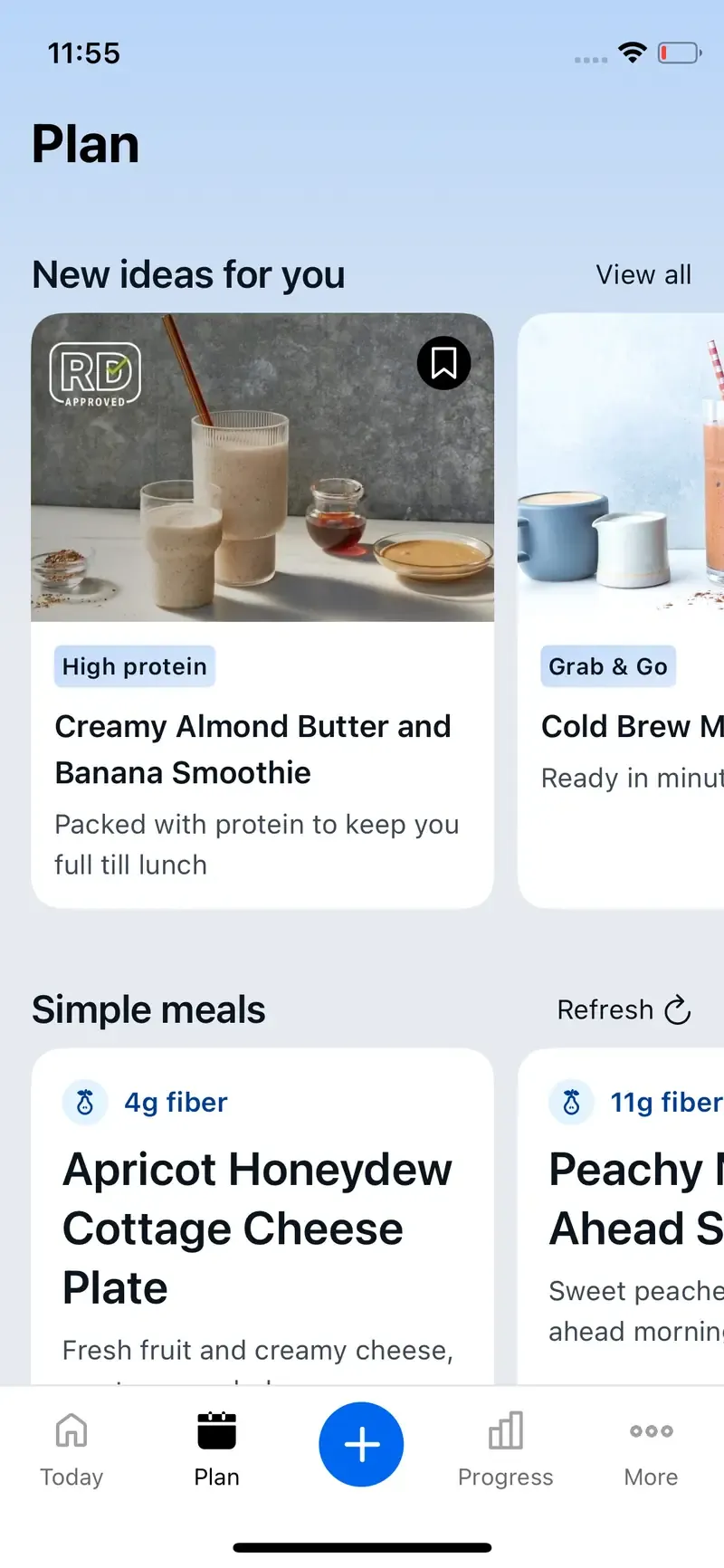
Meal Planner: One of the main differences between Premium and Premium+ is the personalized Meal Planner. MyFitnessPal says Premium+ includes access to 1,500+ goal-friendly recipes that can be used to build personalized weekly meal plans. The planner can take factors such as your nutrition goals, food preferences, cooking time, and foods you want to avoid into account. It can also generate grocery lists and let you log planned meals more easily.
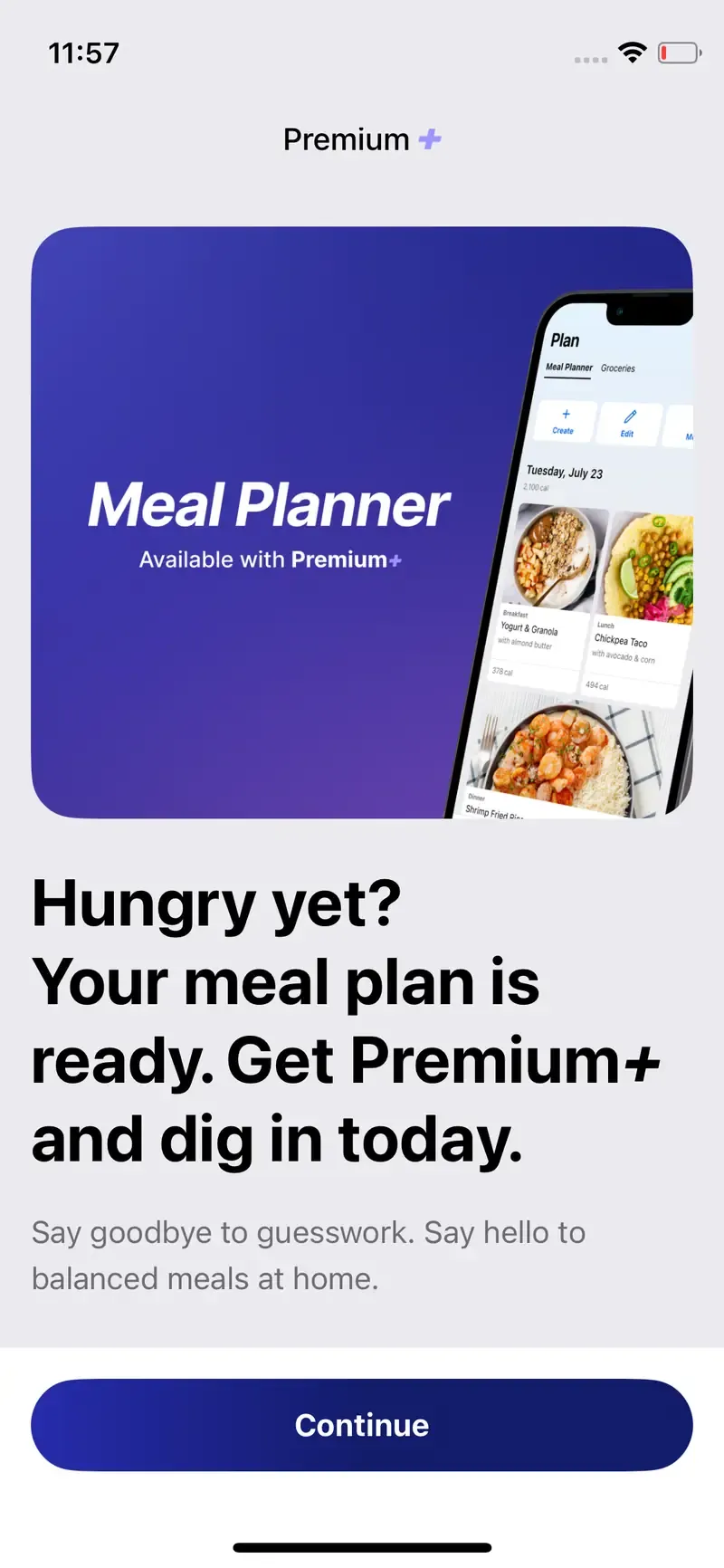
This makes Premium+ more than just an upgraded food diary. It's designed to help with the planning side of eating, not only the tracking side.
For someone who already knows what they want to eat and mainly needs a calorie tracker, this may be more functionality than necessary. But if you want the app to help decide what to cook throughout the week, the Meal Planner is one of the more meaningful Premium+ features.
Custom recipes: MyFitnessPal also allows users to create recipes and save them for future logging. The company says free users can create their own recipes, while the broader Premium ecosystem adds additional convenience and meal-planning tools.
This is particularly useful if you tend to cook the same meals repeatedly. Once you've created a recipe, you don't have to manually add every ingredient from scratch every time.
Exercise and health integrations: MyFitnessPal also connects with partner apps and devices to bring together food, exercise, weight, steps, and other health information.
Intermittent fasting: MyFitnessPal also has an intermittent fasting tracker. It is currently a Premium feature and is available on iPhone and Android, but not on the website.
Pricing and Subscription
MyFitnessPal Pricing
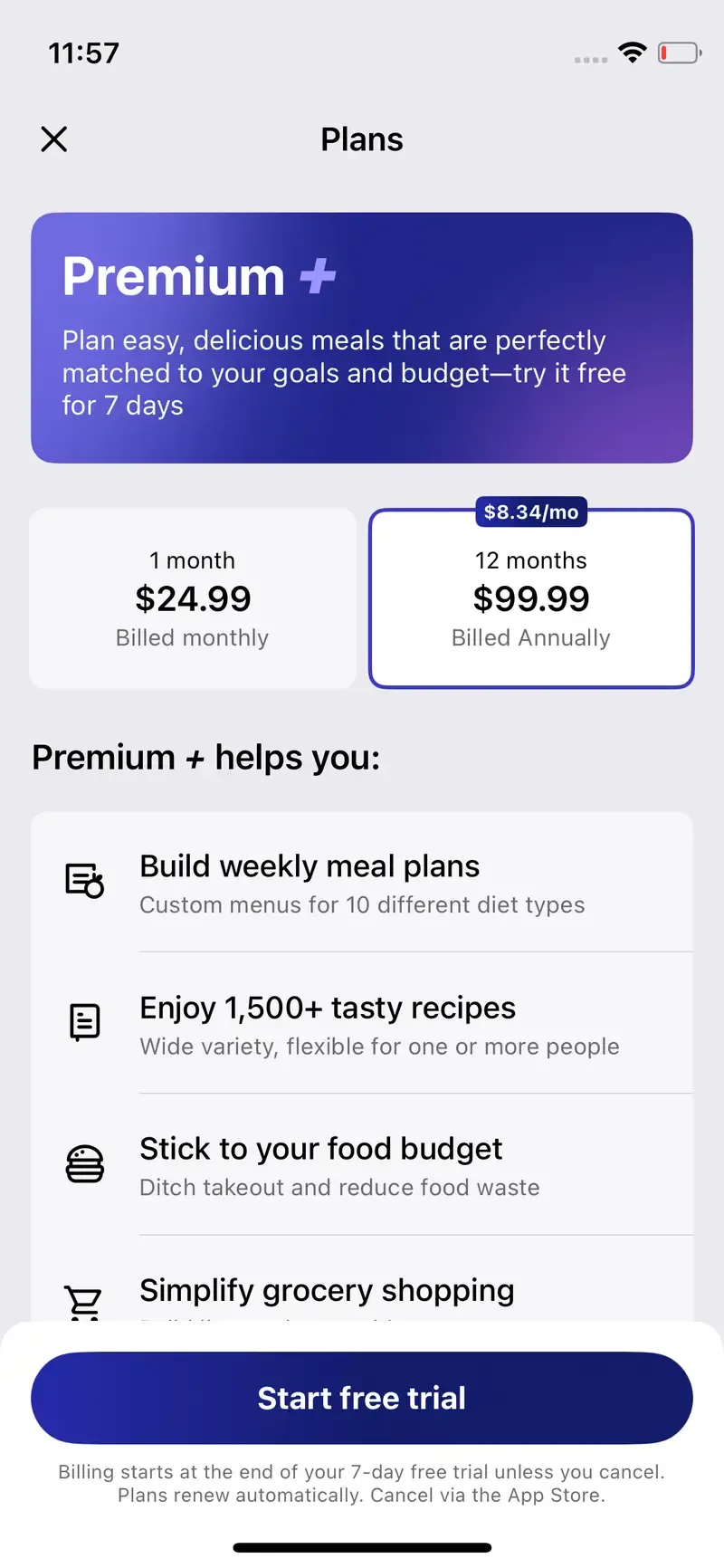
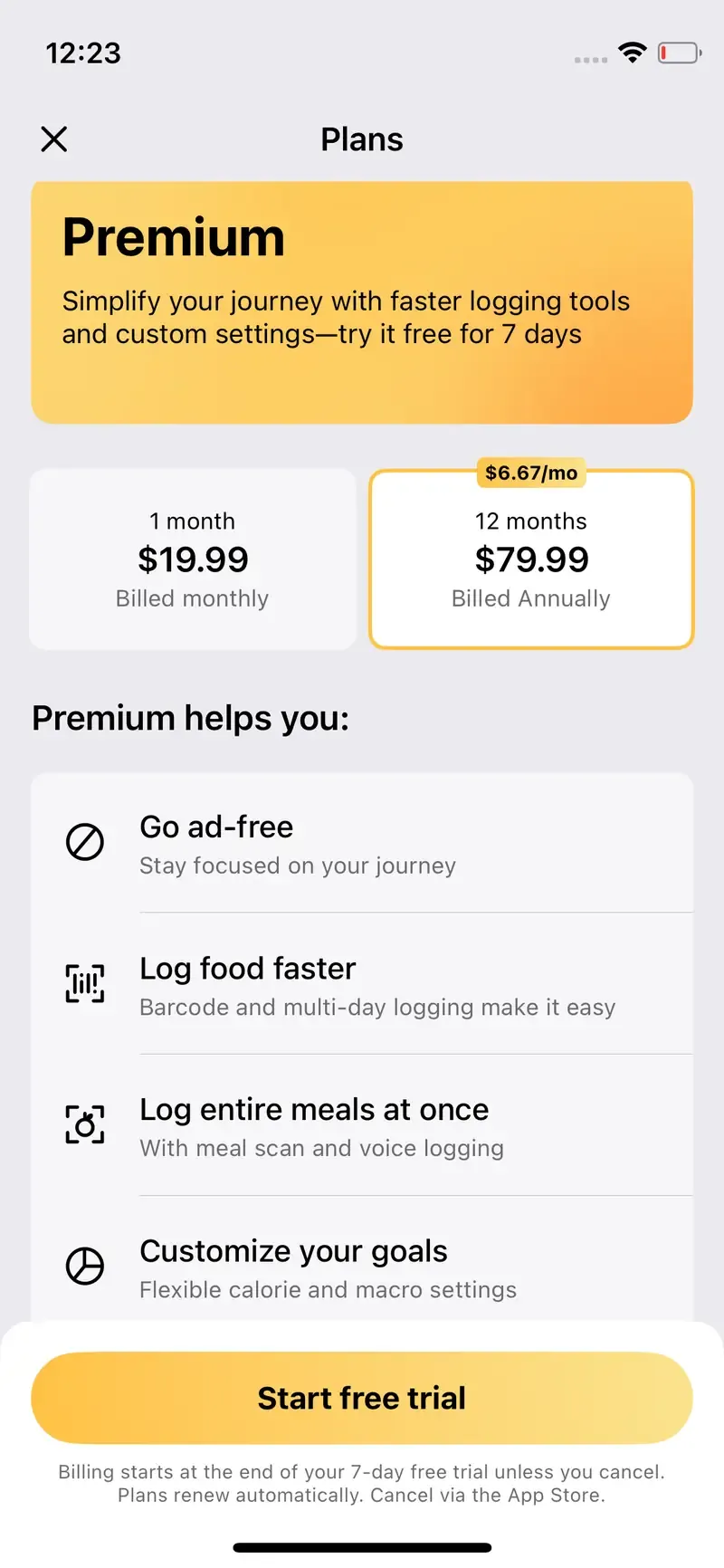
MyFitnessPal has three plans: Free, Premium, and Premium+. Premium costs $19.99 per month or $79.99 per year, while Premium+ costs $24.99 per month or $99.99 per year.
| Plan | Monthly Price | Annual Price | Free Trial |
|---|---|---|---|
| Free | $0 | $0 | — |
| Premium | $19.99 | $79.99 | 7 days* |
| Premium+ | $24.99 | $99.99 | 7 days* |
MyFitnessPal Free, Premium, and Premium+ pricing in 2026
Note: Free-trial availability may vary by platform, account, and offer. During our testing, the subscription screen showed a 7-day free trial.
Does MyFitnessPal Offer Discounts?
During our testing, the standard annual price wasn't the only price we saw. After we declined the initial Premium offer, MyFitnessPal presented us with a 25% discount, bringing the annual price down from $79.99 to $59.99/year.

The 25% Premium discount shown to us after we declined the initial offer.
We wouldn't assume every user will receive the same MyFitnessPal discount. The $59.99/year price was the promotional offer shown to us during testing, and offers may vary by country, platform, account, date, or eligibility.
Free vs. Premium vs. Premium+
| Feature | Free | Premium | Premium+ |
|---|---|---|---|
| Manual food search | ✓ | ✓ | ✓ |
| Calorie & macro tracking | ✓ | ✓ | ✓ |
| Create custom recipes | ✓ | ✓ | ✓ |
| Data export | — | ✓ | ✓ |
| Barcode scanning | — | ✓ | ✓ |
| Meal Scan | — | ✓ | ✓ |
| Voice Logging | — | ✓ | ✓ |
| Ad-free experience | — | ✓ | ✓ |
| Deeper nutrition insights & custom goals | — | ✓ | ✓ |
| Intermittent fasting tracker | — | ✓ | ✓ |
| Workout routines | — | ✓ | ✓ |
| Personalized Meal Planner | — | — | ✓ |
| 1,500+ goal-friendly recipes for Meal Planner | — | — | ✓ |
| Weekly meal plans & grocery lists | — | — | ✓ |
MyFitnessPal feature availability by plan
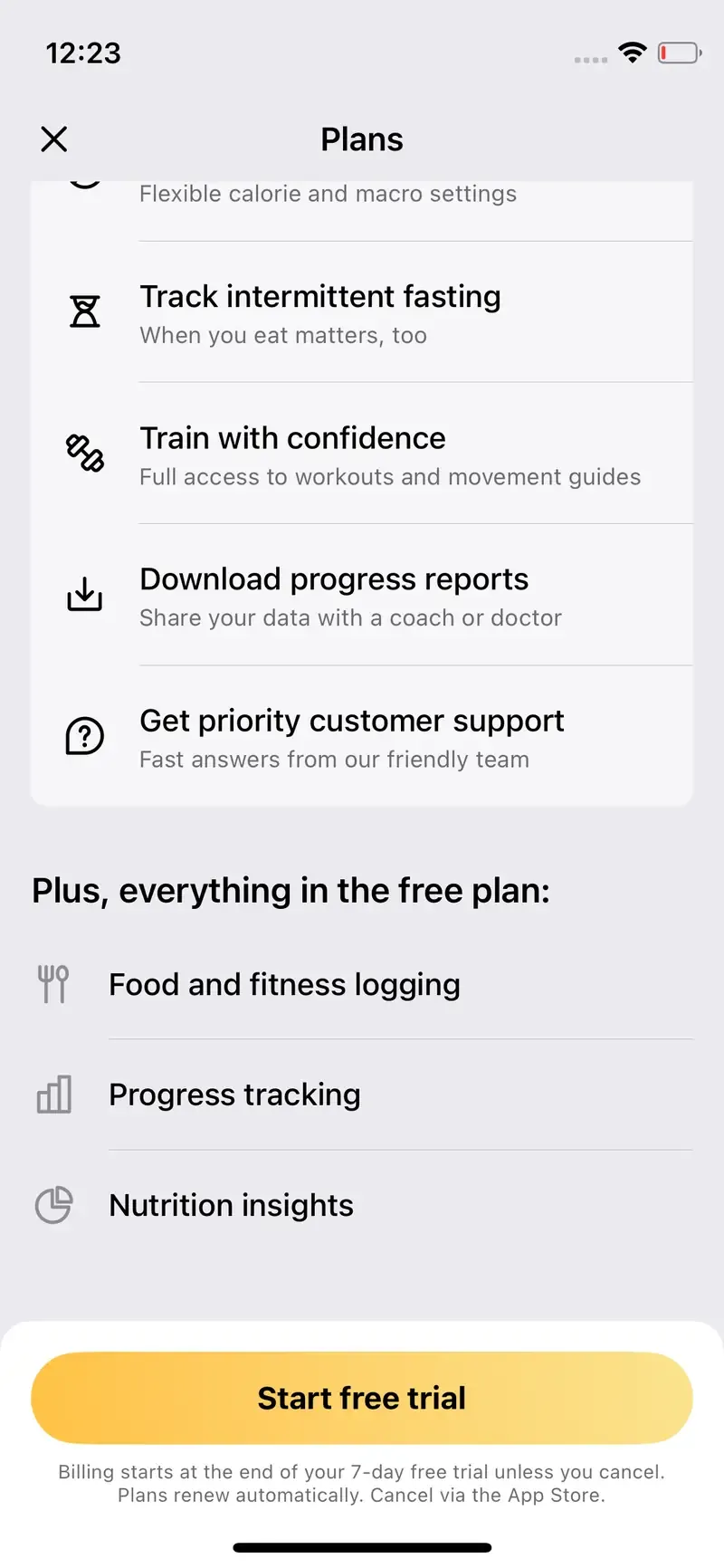
The free tier covers basic manual logging and nutrition tracking. Premium mainly adds faster logging, deeper insights, customization, and an ad-free experience, while Premium+ adds personalized meal planning and grocery tools.
What We Like and Don't Like
What We Like
-
Extremely large food database: MyFitnessPal says its database includes 20.5M+ foods, making it easier to find branded, packaged, and restaurant items.
-
Comprehensive tracking ecosystem: Food, nutrition, exercise, weight, recipes, and health integrations are brought together in one app.
-
Detailed nutrition tools: Premium adds deeper nutrition insights and more control over calorie and macro goals.
-
Strong recipe and meal-planning resources: You can create your own recipes for free, while Premium+ adds personalized meal planning and grocery tools.
What We Don't Like
-
Many convenient logging tools require Premium: Barcode scanning, Meal Scan, and Voice Logging were all paid features in our test.
-
Frequent ads in the free version: We encountered prominent advertising while using the free tier.
-
Premium isn't cheap: The standard annual price we checked was $79.99 for Premium and $99.99 for Premium+.
-
Meal planning requires Premium+: The personalized Meal Planner and its grocery tools are reserved for the highest tier.
Who Is MyFitnessPal Best For?
MyFitnessPal is best suited to people who want a comprehensive food tracker rather than a minimalist food diary.
MyFitnessPal may be especially suitable for people who:
Regularly eat branded or restaurant foods.
Want a large database for manual food search.
Follow structured calorie or macro goals.
Want food, exercise, weight, recipes, and health integrations in the same ecosystem.
It's less suitable if your main priority is a generous free tier or a simple food diary with minimal advertising.
Frequently Asked Questions
Is MyFitnessPal still the best?
MyFitnessPal remains one of the most comprehensive food trackers we tested, especially for database size and its broader food, recipe, exercise, and health ecosystem. Whether it is the best fit depends on what you value: some alternatives offer a more generous free experience, while MyFitnessPal offers greater breadth.
Is there a better tracker than MyFitnessPal?
It depends on what you want. MyNetDiary provided more detailed free nutrition tracking in our test, while apps such as Cal AI prioritize simpler AI-assisted logging. MyFitnessPal remains stronger if you value its large food database and broad tracking ecosystem.
What are the disadvantages of MyFitnessPal?
The biggest drawbacks we noticed were frequent advertising in the free version and the number of convenience features behind Premium. In our test, barcode scanning, Meal Scan, and Voice Logging required an upgrade.
How much does MyFitnessPal cost?
MyFitnessPal Premium is $19.99/month or $79.99/year, while Premium+ is $24.99/month or $99.99/year at the U.S. prices checked for this review. During our testing, we also received a 25% Premium discount that reduced the annual price to $59.99.
Why is MyFitnessPal so expensive now?
MyFitnessPal now places several convenience features behind its paid tiers. Premium includes barcode scanning, Meal Scan, Voice Logging, deeper nutrition insights, custom goals, intermittent fasting, workout routines, and an ad-free experience. Premium+ adds personalized meal planning and grocery tools. Whether that feels expensive depends on how many of those features you use.
Is MyFitnessPal worth it?
MyFitnessPal can be worth paying for if you regularly use barcode scanning, Meal Scan, Voice Logging, deeper nutrition tools, or its broader tracking ecosystem. If you mainly need occasional manual food logging and basic calorie and macro tracking, the free tier may be enough. Premium+ makes the most sense if you'll also use its personalized Meal Planner and grocery tools.
Official feature information
For current plan details, check MyFitnessPal's official feature information.
This article is for general education and is not a substitute for personal medical or nutrition advice.
More From Shelog
Keep Reading
Take Shelog with you
Take Shelog with you
Shelog turns the ideas in this article into a simple daily diary—food, mood, movement, and weight in one calm place.