

How to Lose 5 kg Safely: A Realistic Guide for Women
Want to lose 5 kg without crash dieting? Learn how to choose a realistic timeline, build a flexible plan, and track progress beyond daily scale changes.
Shelog Editorial
Reviewed for clarity and care

Maybe the number arrived in a fitting room. Maybe it followed a doctor's appointment, an old photo, or a morning when your clothes simply felt different. However it appeared, 5 kg—about 11 pounds—can quickly turn from an idea into a countdown.
Then the searching begins. Can I lose it in a month? Should I stop eating carbs? How much do I need to walk? By the third tab, somebody is promising five kilograms in seven days and somebody else appears to survive on cucumber slices.
Let's step out of that noise.
For some women, losing 5 kg can be a reasonable goal. For others, it may be unnecessary, too aggressive, or unsafe. When the goal does fit, a safe approach usually takes multiple weeks or months—not a dramatic seven-day challenge.
This guide will help you decide whether the target makes sense, build a flexible plan, and understand what the scale is actually showing along the way. There will be no dehydration tricks or suspiciously tiny menus. Your plan needs to survive workdays, periods, weekends, dinners out, and the occasional afternoon when a snack quietly becomes dinner.
Your target should fit your body. Your body does not need to squeeze itself into a round number.
First, Does Losing 5 kg Make Sense for You?
A five-kilogram goal looks identical in a notes app. It does not represent the same change in every body.
| Starting weight | 5 kg as a percentage of starting weight |
|---|---|
| 50 kg | 10% |
| 60 kg | 8.3% |
| 75 kg | 6.7% |
| 100 kg | 5% |
These percentages are arithmetic, not recommendations. They show why a goal that may be modest for one person could be substantial for another.
For adults with overweight or obesity, the US National Institute of Diabetes and Digestive and Kidney Diseases (NIDDK) describes 5% to 10% of starting weight over six months as a common initial goal. That guidance does not tell everyone to lose that amount. It connects weight goals to a person's starting point and health instead of treating one round number as universally desirable.
Before you turn 5 kg into a deadline, take a quieter moment and ask:
- Would losing this amount still leave me at an appropriate weight for my body and health history?
- Is the goal connected to my health, comfort, or function—or mostly to a deadline, a comment, or somebody else's body?
- Can I pursue it while eating adequately, recovering from movement, and participating in normal life?
- Would becoming stronger, eating more regularly, or improving a health marker serve me better right now?
There is no failure in discovering that 5 kg is the wrong target. A useful goal gives you direction; it should not make you disappear from your own life.
A general online plan is not appropriate if you are under 18, pregnant, breastfeeding, recovering postpartum, underweight, managing an eating disorder, or dealing with a condition or medication that affects weight or nutrition. A doctor or registered dietitian can help you decide whether weight loss belongs in the plan at all.
How Long Does It Take to Lose 5 kg?
This is usually the question hiding behind the question.
The NHS uses 0.5 to 1 kg per week as a general gradual weight-loss reference. On paper, 5 kg at that pace takes about five to ten weeks.
On paper is doing important work in that sentence.
| Average scale change | Arithmetic time to 5 kg | What it means |
|---|---|---|
| 0.25 kg per week | 20 weeks | A slower example, not a failed one |
| 0.5 kg per week | 10 weeks | The lower end of the NHS general range |
| 1 kg per week | 5 weeks | The upper end, and unsuitable for many people |
None of these rows is a personal delivery date. Many women will need longer, particularly if they have a smaller body, are already relatively lean, or choose a gentler change that leaves more room for food, training, and social life.
Energy needs also change as body weight changes. This is why the NIDDK Body Weight Planner uses a dynamic model rather than assuming every calorie change produces the same result forever.
What about losing 5 kg in one month?
Five kilograms across four weeks averages about 1.25 kg per week, which is faster than the NHS general range. The scale can sometimes fall rapidly at first because body water and stored carbohydrate change, as Mayo Clinic explains in its overview of early weight loss. That does not make 5 kg of fat loss in a month a safe promise for every woman.
Rapid loss has real risks. The NIDDK notes that it can increase the chance of gallstones. NICE guidance reserves diets of 800 to 1,200 calories—and especially diets below 800 calories—for selected people in specialist, supported programs. They are not internet challenges or long-term plans.
If a birthday, holiday, wedding, or beach trip is creating the deadline, keep the event and loosen the number. You deserve to arrive with enough energy to enjoy the thing you were preparing for.
Why the First Week Can Feel So Convincing
Picture a very familiar Monday. You cook at home, skip a few restaurant meals, drink less alcohol, and take two extra walks. By Thursday, the scale is down 1.2 kg. It feels as if the five-kilogram target might be only a couple of weeks away.
Then Sunday arrives after dinner with friends, and 0.8 kg appears to come back overnight.

Neither number tells a complete story. Your scale measures total weight: fat, muscle, body water, stored carbohydrate, food being digested, and more. A sharp early drop can include water. A later jump can reflect water and digestion without representing sudden fat gain.
Menstrual timing can make the story noisier. In a small study of 42 women, average body weight was about 0.45 kg higher during menstruation, mainly alongside increased extracellular water. That is one small study, not a forecast for your cycle, but it illustrates why two isolated weigh-ins can be unfair judges.
So five kilograms of scale weight is not automatically five kilograms of fat. Your first week is useful information; it simply is not the trailer for every week that follows.
If daily numbers keep taking over the plot, use our two-week weight-loss check to put them in context. Comparing several weeks is far more useful than asking a low-water Monday to compete with a salty-dinner Tuesday.
How to Lose 5 kg Safely, Without Rebuilding Your Whole Life
The internet version of a fresh start often happens all at once: a new calorie target, new groceries, five workouts, no dessert, no bread, and a water bottle large enough to require its own seatbelt.
Real life tends to reject that plan by Wednesday.
A sustainable plan starts more quietly. You learn what your ordinary week looks like, choose a small number of changes with a clear purpose, and wait long enough to see what they do.
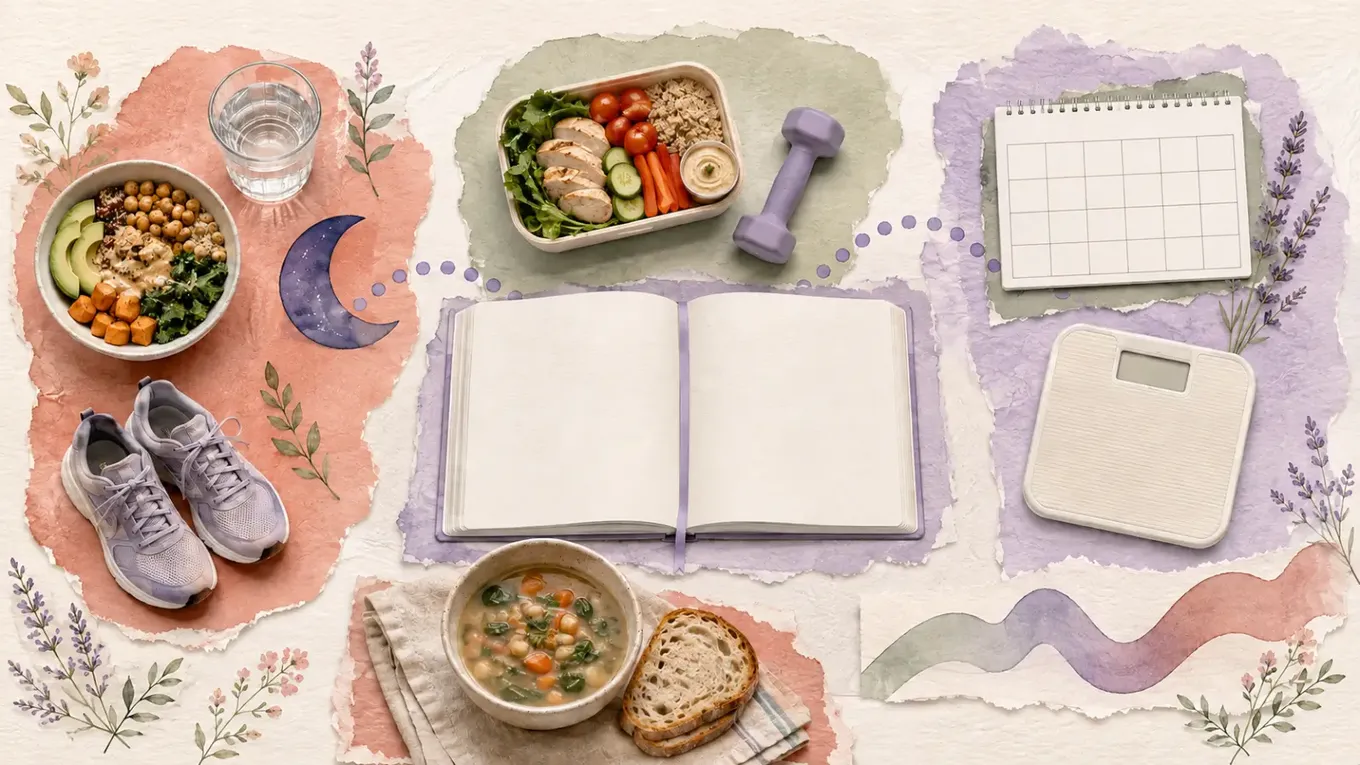
Week zero: meet your current routine
Spend seven to fourteen days observing rather than performing. This is an organizational window, not a biological rule. Include normal workdays and a weekend if you can.
Notice where the day flows and where it gets difficult:
- Which meals keep you comfortable for several hours?
- When does hunger turn into “I will eat the first thing I can find”?
- Which drinks, bites, or portions happen almost invisibly?
- How often do you walk, train, or sit for long stretches?
- What changes when sleep is short, work is intense, or your period is approaching?
- What does your weight look like under reasonably similar conditions, if weighing feels okay?
This is not an investigation into your moral character. It is the part of the story where you finally meet the routine you are trying to change.
Choose a starting estimate, not somebody else's calories
Energy needs vary with body size, age, activity, and other individual factors. The number used by a friend or creator may have very little to do with your needs.
Shelog's maintenance calorie calculator can estimate the energy that may maintain your current weight. Treat the result as a starting hypothesis, not a prescription. Your real records and longer weight trend will tell you whether the estimate fits.
You do not have to count every calorie. You can observe your usual meals and portions, then choose one or two changes that are likely to reduce energy intake without shrinking your life around food.
Build meals that can carry you to the next one
NICE recommends flexible, individualized dietary approaches that consider preferences, culture, finances, health conditions, and eating-disorder risk. In practical terms, your weight-loss meals are still allowed to look like your meals.
A satisfying plate will often include:
- a protein source you enjoy
- vegetables or fruit for variety and fibre
- a carbohydrate source that supports your day and activity
- some dietary fat for flavour, satisfaction, and nutrition
The helpful change may be almost unglamorous. You add a real lunch because a coffee-and-good-intentions lunch keeps ending in a 4 p.m. pantry tour. You keep a protein-and-fruit snack at work. You plate the takeaway and save the rest before sitting down. You swap a drink you barely enjoy while keeping the dessert you genuinely do.
A Purdue University-led systematic review found that protein intakes above the RDA modestly reduced lean-mass loss during energy restriction across the included adult studies. It supports paying attention to protein, without establishing one perfect target for every woman. Shelog's protein intake calculator can provide an estimate if a number would help; it is not a daily exam.
Let movement add to your life
Movement can support health, fitness, muscle, and your overall energy balance. It does not need to serve as repayment for dinner.
The US Physical Activity Guidelines recommend that adults work toward 150 to 300 minutes of moderate aerobic activity per week, plus muscle-strengthening work on at least two days. They also encourage inactive adults to begin with small amounts and build gradually.
That may look like two strength sessions, walks after lunch, a weekend swim, dancing, cycling, or active errands. Choose movement that has a realistic place in your calendar. The best theoretical workout has limited value when it requires a version of your life that never occurs.
Among adults with overweight or obesity, a systematic review and meta-analysis found that adding resistance training to calorie restriction preserved lean mass better than dieting alone. You do not need to become a bodybuilder. You are giving your body a reason to hold on to useful tissue while weight changes.
Keep a low-energy version of the plan
There will be a busy Thursday. The workout will feel impossible, the vegetables may still be at the shop, and your enthusiasm will have left the group chat.
Decide in advance what counts on that day. Perhaps it is a ten-minute walk, a familiar easy dinner, and going to bed instead of trying to “catch up.” The NIDDK includes adequate sleep and stress management among the foundations of a healthy weight-loss program.
A smaller version keeps the story moving. It is often more valuable than one heroic day followed by three days of recovery.
One Month In: How to Read What Happened
Imagine that four weeks have passed. You have eaten more regular lunches, completed most of your strength sessions, and taken more walks. The scale is down 1.3 kg—less than the fantasy timeline, but clearly moving.
Do you tighten the plan?
Probably not just because the calendar turned. Start with the full record:
- Is the multiweek weight trend moving?
- Did you follow the plan often enough to evaluate it?
- How are hunger, energy, sleep, mood, periods, and training going?
- Are strength, measurements, or clothing fit telling a useful second story?
- Did travel, illness, restaurant meals, or menstrual timing temporarily affect the scale?
Then make one of three calm decisions:
- Continue. The plan is working and feels manageable.
- Adjust one element. The trend is quiet, the records suggest why, and the goal still makes sense.
- Pause or change the goal. Your health, symptoms, or current life needs something different.
Changing the goal after learning more is not quitting. It is exactly what a thoughtful review is for.
Our guide to slow and steady weight loss can help you recognize progress that does not arrive on a dramatic schedule. If several weeks of comparable records show that an established trend has truly stopped, move to the more focused weight-loss plateau guide.
Give the Scale a Supporting Role
Five kilograms is a scale goal, but the scale should not be the only character with dialogue.
Keep a small group of signals:
- Weight trend: Compare several weeks under reasonably consistent conditions rather than demanding a new low each morning.
- Energy, hunger, and mood: Persistent exhaustion, intense hunger, irritability, poor concentration, or food preoccupation deserve attention—not a lecture about willpower.
- Strength and recovery: A few repeated exercises can show whether you are maintaining performance. Repeated injuries or a steady decline point in the other direction.
- Optional measurements or clothing fit: Use the same technique and check occasionally. A slightly different tape position does not need to become a weekly drama.
- The habits you repeated: Regular meals, walks, training, and returning after an unusual day explain more than a single “perfect” streak.
The aim is not to collect every possible metric. Choose enough information to make the next decision less emotional and more useful.
A Note for Women: Context Matters, Myths Do Not Help
Women do not need a universal “female metabolism” diet. An appropriate energy deficit, adequate nutrition, movement, recovery, and monitoring remain the basic framework.
Personal context still matters. A smaller body may have less room for a large calorie reduction. Menstrual water shifts can blur short-term progress. Pregnancy, breastfeeding, postpartum recovery, perimenopause, menopause, health conditions, contraception, and other medicines may change symptoms, priorities, or what is safe.
That is a reason to personalize the plan—not to buy a hormone detox with pink packaging.
Long-term under-fuelling deserves particular care. The International Olympic Committee's consensus on Relative Energy Deficiency in Sport describes how problematic low energy availability can affect menstrual and reproductive health, bone, immunity, psychological health, cardiovascular health, performance, and injury risk. These concerns can extend beyond elite athletes.
Pause the weight-loss push and seek qualified help if periods stop or become increasingly irregular, energy and performance keep falling, or you are frequently dizzy, cold, injured, or distressed around food. Those are not shiny badges of commitment.
How Shelog Can Help You Stay With the Plan
When losing 5 kg is an appropriate goal, progress is built from many fairly ordinary days. That is why memory alone can be unreliable. The difficult afternoon is vivid; the three steady weeks before it are easy to forget.
Shelog brings food, mood, workouts, water, and weight into one diary. Looking back, you can ask practical questions. Did a satisfying lunch make the afternoon easier? Are strength sessions becoming more consistent? Did travel, a period, or a restaurant weekend appear beside a temporary weight jump?
Weight Trend estimates direction and uncertainty from recent weight records. It does not measure fat, muscle, water, calories, hormones, or metabolism, and it cannot explain why weight changed. Use it as one part of the story alongside habits, health, energy, and strength.
Shelog cannot decide whether you should lose 5 kg or promise when you will reach it. It can keep the process visible, so one busy day does not erase everything you have learned about yourself.
Keep your food, mood, movement, water, and weight together with Shelog.
When Personal Support Matters
Talk with a doctor or registered dietitian before or during weight loss if you:
- are under 18, pregnant, breastfeeding, or recently postpartum
- are underweight or unsure whether losing 5 kg is appropriate
- have a current or previous eating disorder
- have diabetes, digestive or kidney disease, gallstones, hormonal concerns, or another condition affecting nutrition or weight
- take medicine that may affect appetite, fluid balance, blood glucose, or weight
- have missed or increasingly irregular periods
- experience persistent dizziness, fatigue, cold, pain, injury, declining performance, or distress around eating and weighing
- have followed a consistent plan but your weight changes unexpectedly
General information cannot evaluate your health history. A few weeks of records may help a professional understand your routine, symptoms, and trend, but diagnosis and treatment belong with them.
Frequently Asked Questions
Can I lose 5 kg in one month?
The scale can change by 5 kg in a month, and part of an early change may be water. That does not prove 5 kg of fat loss or make the pace safe for you. Five kilograms in four weeks averages about 1.25 kg per week, above the NHS general gradual range. Do not use crash dieting or dehydration to force the deadline.
How many calories should I eat to lose 5 kg?
There is no safe universal calorie target for women. Needs vary with body size, age, activity, health, and other factors. Begin with an individual maintenance estimate and a modest change, or work with a registered dietitian. NICE places diets of 800 to 1,200 calories—and especially those below 800—inside selected, professionally supported programs rather than generic online advice.
Can walking help me lose 5 kg?
Walking can contribute to activity, health, and energy expenditure when repeated consistently. Whether it leads to a 5 kg loss depends on your total energy balance, starting point, time frame, and other changes. Pairing aerobic activity with muscle-strengthening work gives your plan benefits beyond the scale.
Can I target 5 kg of belly fat?
No food or exercise plan can promise that an exact 5 kg will come from one body area. A systematic review of 84 randomized trials found that several kinds of exercise reduced visceral fat on average in adults with overweight or obesity, but that cannot predict where each kilogram will come from for an individual woman. Waist measurements can add context; a 5 kg scale change still cannot identify how much came from abdominal fat—or from fat at all.
What if I lose some weight and then stop?
Check whether several weeks of comparable records show a genuine plateau rather than temporary water fluctuation. Review consistency, portions, activity, sleep, medication, and health changes. If the goal remains suitable, adjust one repeatable part of the plan and reassess. Seek professional advice when symptoms or unexplained changes are present.
Will I regain the 5 kg?
No method can guarantee maintenance. Think about the “after” before reaching the number: which meals, movement, and support can continue? Keep the routines that help, expect normal scale variation, and review the trend without treating every increase as an emergency.
The Takeaway
Perhaps 5 kg is still the right goal after reading this. Now it is no longer just a number following you around—it has context.
You know that the five-to-ten-week window is arithmetic based on a general range, not a promise. You know the scale can mix fat change with water, digestion, stored carbohydrate, and muscle. Most importantly, you have a process: meet your real routine, choose a few useful changes, keep a low-energy version for difficult days, and review the whole story after several weeks.
The best plan will rarely produce the most exciting first-week headline. It should give you enough food, energy, flexibility, and information to keep making good decisions long after the countdown loses its shine.
Sources
- NIDDK: Choosing a Safe and Successful Weight-loss Program
- NIDDK Body Weight Planner
- NIDDK: Dieting and Gallstones
- NHS: Tips to Help You Lose Weight
- NICE NG246: Physical Activity and Diet
- Mayo Clinic: Getting Past a Weight-loss Plateau
- US Department of Health and Human Services: Physical Activity Guidelines for Americans
- Obesity Reviews: Effect of Resistance Exercise on Body Composition
- Advances in Nutrition: Protein Intake and Lean Mass During Energy Restriction and Resistance Training
- American Journal of Human Biology: Changes in Body Weight and Body Composition During the Menstrual Cycle
- Obesity Reviews: Exercise Types and Visceral Adipose Tissue
- British Journal of Sports Medicine: 2023 IOC Consensus Statement on Relative Energy Deficiency in Sport
This article is for general education and is not a substitute for personal medical or nutrition advice.
More From Shelog
Keep Reading
Take Shelog with you
Take Shelog with you
Shelog turns the ideas in this article into a simple daily diary—food, mood, movement, and weight in one calm place.