

How to Get Your Healthy Habits Back on Track—Without a Life Overhaul
Meals, movement, and bedtime feeling scattered? Restart your healthy habits with one manageable change, a realistic fallback, and less pressure to be perfect.
Shelog Editorial
Reviewed for clarity and care

You open the fridge after a long day. The groceries you meant to buy are still on a list, your walking shoes haven't left the hallway, and dinner is whatever takes the least effort. You make a mental note to get everything back on track on Monday.
But Monday doesn't need another list of ten things to fix.
To get your healthy habits back on track, choose one part of your day that has become difficult, decide on a small action you can realistically repeat, and make room for interruptions. Start with the next opportunity—not a perfect new week.
This is about meals, movement, and everyday routines. It isn't a plan for solving a financial crisis, treating depression, or rebuilding your whole life. Sometimes the most useful place to begin is much more ordinary: having something available for lunch tomorrow.
Find the Part of the Day That Keeps Unravelling
Before setting a goal, look at what changed.
Perhaps you used to cook after work, but your commute is now longer. A holiday shifted your evenings later. You're caring for someone or working different hours. The routine that worked last month may simply need adjusting.
“I've lost all my healthy habits” is difficult to act on. “I keep reaching 3 p.m. without having lunch” gives you somewhere to start.
Ask yourself: Which recurring moment would I most like to make easier?
It might be getting food together before leaving home, making time to move between work and dinner, or ending the evening without another hour of scrolling. Choose the one that matters to you now. You don't need to rank every habit or pick the most impressive goal.
Also notice whether you need a different plan or practical help. A reminder cannot create a lunch break your workplace won't allow. If the problem is time, money, care responsibilities, or access, the next step might be asking for support rather than adding a task.
Choose an Action, Not a New Identity
“Be healthier” leaves you with decisions to make all day. A specific action is easier to return to.
Try: “Before I leave for work, I'll put lunch in my bag.” Or: “After I close my laptop, I'll walk to the end of the street and back.” Adapt the movement to your ability and surroundings; a seated activity or a few comfortable movements may fit better.
The National Institute of Diabetes and Digestive and Kidney Diseases recommends beginning with small, specific changes and planning around obstacles. You can use that principle without adopting a complicated challenge.
Choose an action you can picture yourself doing on a fairly busy day. If it depends on a long shopping trip, new equipment, or a free evening, simplify the setup first.
For lunch, that could mean keeping ingredients for a familiar sandwich available. For movement, it could mean choosing a route from your front door. For your evening, it might mean putting your charger somewhere other than beside the sofa.
These aren't universal prescriptions. They are examples of turning a good intention into a decision you don't have to keep making.
Make Tomorrow Easier in One Place
You can start with food, movement, or the end of the day. You do not need to start with all three.
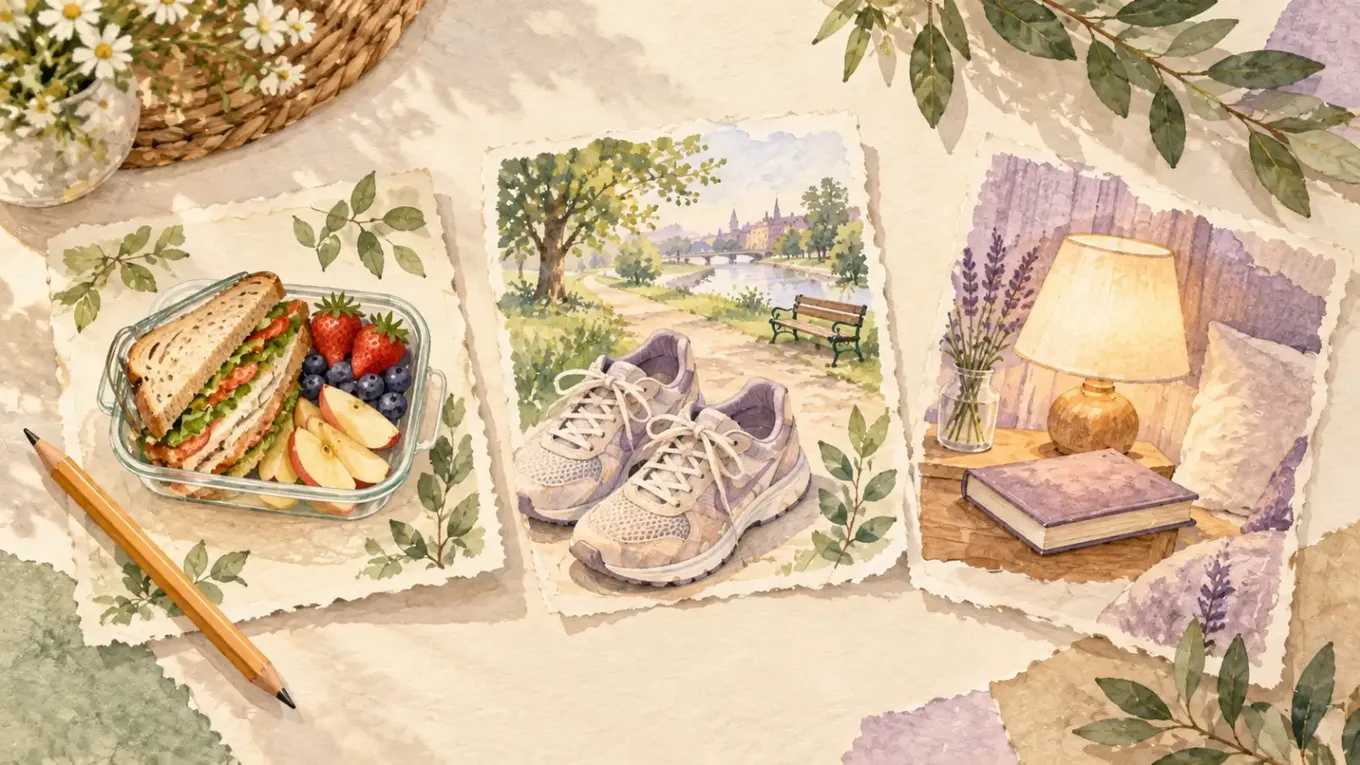
If meals have become an afterthought
Choose one meal that keeps getting squeezed out and give it an easy default. Leftovers, a sandwich with fruit, or microwave rice with beans and frozen vegetables can all be practical options, adjusted to your preferences and dietary needs.
A meal doesn't become a failure because it came from a freezer or took five minutes. If you enjoy cooking, leave the new recipe for a day when you actually want to make it.
The task is making food available—not creating a stricter eating day to compensate for last week.
If movement keeps getting postponed
Pick something familiar and manageable. A short walk, an activity you enjoy at home, or a comfortable return to your usual routine gives you a concrete starting point.
After illness, injury, or a long break, follow any medical advice you have and adjust activity to your current capacity. A restart isn't the moment to test an old personal best.
If getting to the gym is the specific challenge, our guide to fitting gym workouts into a busy routine covers scheduling and shorter backup sessions. You don't have to solve that entire schedule today.
If the evening keeps drifting
Choose one clear stopping point: finish an episode before starting another, set out what you need for morning, or move from work to a quieter activity.
If sleep timing itself has shifted, see our guide to getting your sleep schedule back on track. Preparing for bed is a practical step; it isn't a guarantee that you'll fall asleep or a treatment for ongoing sleep problems.
What a Modest Restart Can Look Like
Imagine lunch is the first thing you want to restore. Tonight, you check what is already in the kitchen and put together something you can take tomorrow. You leave the bag where you will see it before going out.
Tomorrow's meeting runs over. Lunch happens later than planned, but it is there. You notice the problem wasn't preparing food; it was finding a chance to eat it. Your next adjustment might be checking the calendar for a realistic break or speaking to someone about protecting that time.
That is a more useful result than deciding the whole day was unsuccessful because it didn't follow the plan.
Once this part of the day feels manageable, you can consider something else. There is no deadline for adding a second habit. Nor does a successful lunch require a workout and an early bedtime to make it count.
Keep a Record You Can Actually Use
When a week is busy, it can be hard to remember what happened beyond “I didn't manage much.” A few notes can make the picture more specific.
You might record a meal, an activity, and how the day felt. Then, when you look back, ask what made your chosen action easier or harder. Did having leftovers help? Was the walking route inconvenient? Did the same late meeting interrupt lunch twice?
NIDDK's habit-change guidance suggests recording both actions and feelings as part of reviewing progress. A record can prompt useful questions; it doesn't prove why your mood, appetite, or energy changed.
Shelog gives you a place to log food, exercise, and mood in the same daily journal. You can revisit everyday entries rather than trying to reconstruct the week from memory. Routine+ also offers Challenges and Helpers for everyday wellness situations, if you would like more guidance. Some features require Premium.
You don't have to use every feature or make every entry. If tracking turns into a source of guilt, comparison, or pressure to restrict food, simplify it or stop. The journal should serve you, not become another demand.
When You Miss the Habit, Change the Next Step
Suppose you forget your lunch. The useful response is finding something to eat—not deciding you have to skip it, cook an elaborate dinner, or restart next Monday.

If one interruption happens, resume when you next can. If the same interruption keeps happening, revisit the setup. Maybe lunch needs to stay in the fridge at work, or the walk needs a different time. You may also decide that this isn't the habit to work on right now.
It helps to make the fallback specific: “If I don't pack lunch, I'll choose one nearby option I know I can afford.” A fallback should reduce the burden, not set a harder task as a penalty.
You can ask someone for practical help, too. A shared shopping trip, a walking companion, or someone taking over an evening chore may be more useful than another motivational reminder.
When This Is More Than a Routine Problem
Feeling disorganized after a busy stretch is different from struggling to eat, care for yourself, or get through ordinary tasks.
If low mood, hopelessness, loss of interest, or major changes in sleep or appetite are persistent, worsening, or affecting daily life, talk with a healthcare professional. You do not need to wait until things become severe to ask for help. The National Institute of Mental Health explains when symptoms call for professional support.
If you have thoughts of suicide or urges to hurt yourself, seek immediate help. In the U.S., call or text 988; in a life-threatening emergency, call 911. Outside the U.S., contact your local crisis service or emergency number.
An app or routine can be a support for everyday life. It cannot replace mental healthcare, medical treatment, or help with unsafe circumstances.
Questions About Restarting Healthy Habits
Should I change my eating, exercise, and sleep at the same time?
You can make changes in more than one area, but you don't have to. When time or capacity is limited, choosing one manageable action is a reasonable place to begin. Keep basic needs and any care plan in view; focusing on one habit doesn't mean neglecting the rest of your health.
How long will it take to feel back on track?
There isn't a fixed number of days. For now, look for practical signs: the action is easier to arrange, you can return after a missed day, or you understand what gets in the way. These are useful observations, not a promise about when a habit becomes automatic.
Do I need to count calories to restart healthy eating?
Not for the practical steps in this guide. Making a meal available, choosing something you enjoy, and finding time to eat don't require a calorie total. If you have an individualized nutrition plan, follow the advice of your care team rather than replacing it with a generic routine.
Start With Tomorrow, Not a Whole New Life
You don't need to prove that you're a different person by Monday. Choose something useful and small enough to fit the day you actually have.
If you'd like a place to keep meals, movement, and mood together as you restart, download Shelog. Begin with the entries that are useful to you, and let the record help you decide what to try next.
Sources
This article offers general wellness information, not individualized medical or mental health advice.
This article is for general education and is not a substitute for personal medical or nutrition advice.
More From Shelog
Keep Reading
Take Shelog with you
Take Shelog with you
Shelog turns the ideas in this article into a simple daily diary—food, mood, movement, and weight in one calm place.